Correct answer — B. Stereotactic ablative radiotherapy, then surveillance chest CT
Correct.
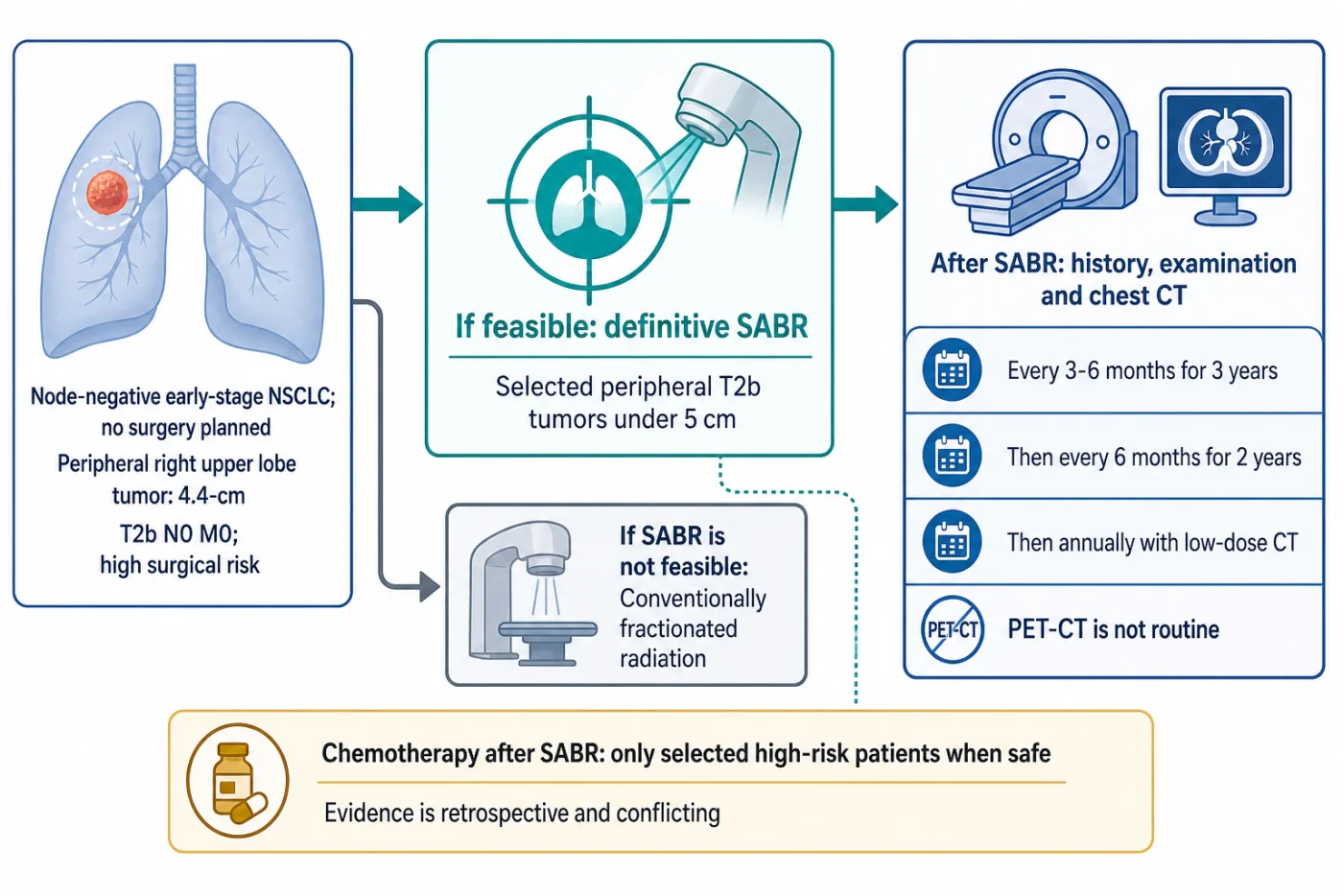
Node-negative early-stage NSCLC that will not be treated with surgery is treated with definitive radiation, preferably stereotactic ablative radiotherapy (SABR). This applies to stage I and to selected node-negative stage IIA tumors such as this 4.4-cm T2b N0 lesion, and it includes patients at high surgical risk from poor lung or cardiac function. For T2b tumors SABR is an option for selected larger tumors, and a peripheral tumor under 5 cm fits that selection.
SABR delivers a very high dose in few fractions to a small, tightly conformal target, using image guidance and motion management. Keeping the high-dose volume small is what makes it practical in a patient with little pulmonary reserve. Regimens with a biologically effective dose of at least 100 Gy are associated with better local control and survival than less intensive regimens.
In RTOG 0236, a phase 2 study of biopsy-proven peripheral T1-T2 N0 tumors under 5 cm in medically inoperable patients, 54 Gy in 3 fractions gave a 3-year primary tumor control rate of 97.6% and a 3-year overall survival of 55.8%. Grade 3 adverse events occurred in 12.7% of patients and grade 4 in 3.6%, with no grade 5 events. In the randomized CHISEL trial of inoperable peripheral T1-T2a tumors, local progression occurred in 14% with SABR versus 31% with standard radiotherapy (HR 0.32 for freedom from local failure), without an increase in major toxicity.
These data have limits. RTOG 0236 was single-arm and included only 11 T2 tumors among 55 evaluable patients, CHISEL enrolled only T1-T2a tumors in patients with ECOG 0 or 1, and SABR is not proven equivalent to lobectomy. The 3-year rate of disseminated failure in RTOG 0236 was still 22.1%, so excellent local control does not remove systemic risk. Both trials treated peripheral tumors: for central tumors, risk-adapted regimens of 4 to 10 fractions are used, because 54 to 60 Gy in 3 fractions is unsafe there.
For this patient, treat the peripheral 4.4-cm tumor with SABR, then follow him with a history, physical examination and chest CT every 3 to 6 months for 3 years, then every 6 months for 2 years, then annually with low-dose CT. PET-CT is not routine in surveillance. Late recurrences have been reported more than 5 years after SABR, and selected patients with a recurrence after SABR may benefit from re-treatment with SABR or surgery.
Adjuvant systemic therapy after radiation may be considered for high-risk stage II disease, especially T2b, and chemotherapy after SABR may be considered for large tumors in selected patients for whom it is safe. The support is retrospective: a National Cancer Database series of tumors of 5 cm or more linked chemotherapy to longer survival, and its authors called the result hypothesis-generating. With FEV1 32%, home oxygen, CAD, CKD3 and ECOG 2, this man is not a patient for whom chemotherapy is safe, so adding it (E) is the trap. Conventional radiation (A) is an alternative when SABR is not feasible, chemoradiation (C) treats nodal or stage III disease, and chemotherapy alone (D) gives no curative local control.