Correct answer — C. Stage IIIB; concurrent chemoradiation, then durvalumab
Correct.
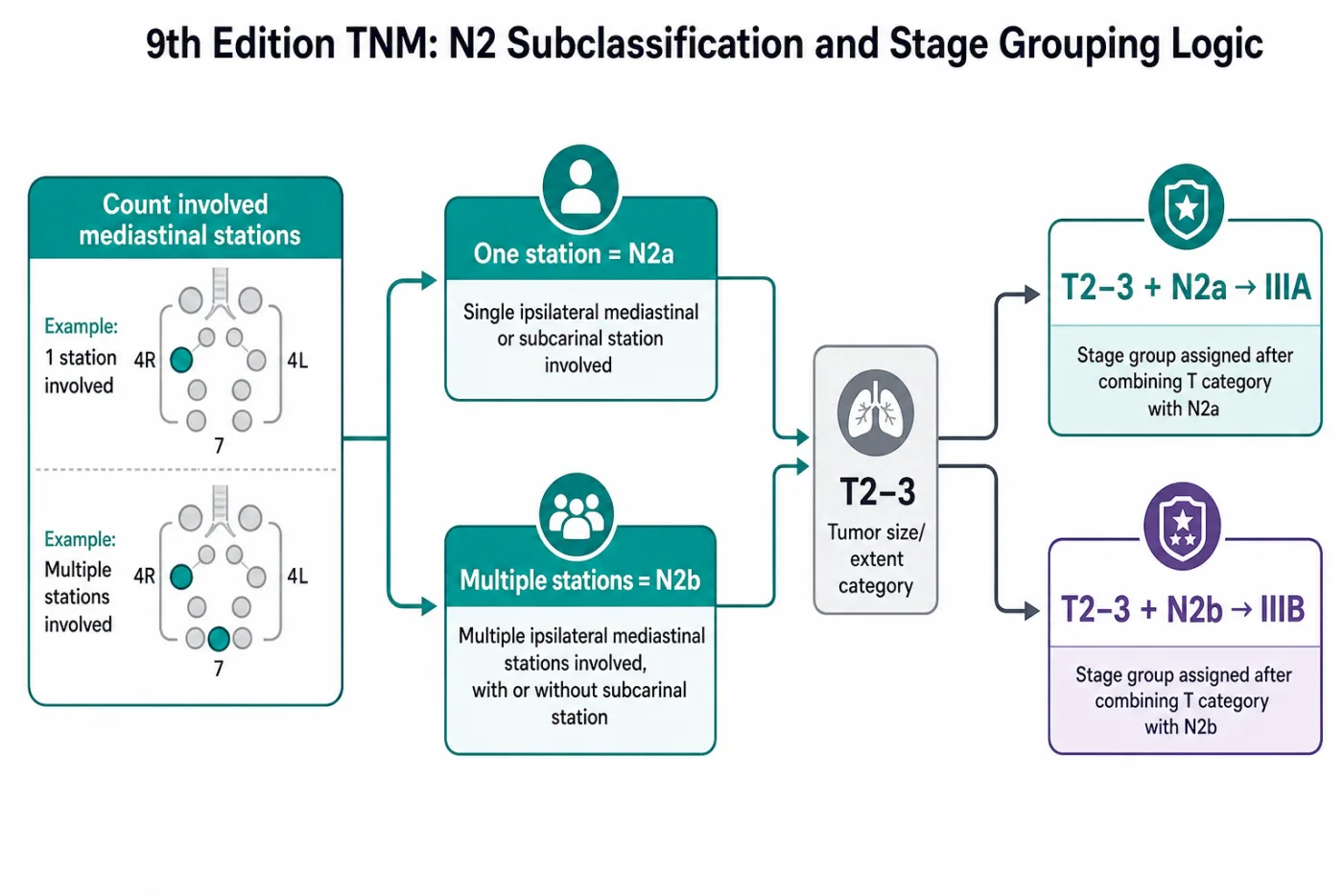
The 9th edition TNM splits N2 by the number of involved stations: N2a is a single ipsilateral mediastinal or subcarinal station, and N2b is multiple ipsilateral mediastinal stations, with or without the subcarinal station. The stage group depends on the T category plus the N2 subtype, so the stations must be counted before the stage is assigned: T2-3 with N2a is stage IIIA, whereas T2-3 with N2b is stage IIIB.
In the 9th edition, T1 N2a is stage IIB; T1 N2b and T2-3 N2a are IIIA; T2-3 N2b, T4 N2a-b and T1-2 N3 are IIIB; and T3-4 N3 is IIIC. The new N2 subcategories were introduced to add granularity about the anatomic extent of nodal disease.
The International Association for the Study of Lung Cancer staging project analyzed 76,518 patients, with N2a and N2b considered in the survival analyses, and assigned T2aN2b and T2bN2b to stage IIIB. In a separate cohort of 6,649 patients who had curative surgery for NSCLC, survival differed significantly between each pair of adjacent N categories (N0, N1, N2a, N2b), for both overall and recurrence-free survival.
This evidence comes from surgical series and a staging database, and it is not uniform: in another resected cohort of 1,754 patients, overall survival tended to be better with pN2a than with pN2b but the difference was not significant (p = 0.083). The stage group describes anatomic extent; it does not by itself choose the treatment.
For this patient, the mass is 3.4 cm, so T2a, and two stations (4R and 7) are involved, so N2b with M0: stage IIIB. Resectability is decided by thoracic surgery before any therapy starts. Systemic therapy followed by surgery is considered only in selected patients who are fit, with single-station, non-bulky N2 disease that needs only a lobectomy. His nodes are multistation and bulky (3.2 and 3.6 cm) and his reserve is borderline, so definitive concurrent chemoradiation is the plan. In the guideline survey, none of the centers considered upfront surgery for multistation or bulky N2 disease, and only 27% would consider surgery after neoadjuvant therapy for multistation bulky disease.
Consolidation durvalumab rests on the PACIFIC trial: patients with unresectable stage III NSCLC and no progression after concurrent chemoradiation, WHO performance status 0 or 1 and any PD-L1 status, were randomized 2:1 to durvalumab for 12 months or placebo. In the updated exploratory analysis about 5 years after the last patient was randomized, estimated overall survival was 42.9% versus 33.4% and progression-free survival was 33.1% versus 19.0%.
So the PD-L1 result of 20% does not decide whether he receives durvalumab. He has no EGFR exon 19 deletion or L858R mutation, so durvalumab follows radiation if there is no progression, and additional chemotherapy after radiation is not added. Had his tumor carried one of those EGFR mutations, osimertinib would replace durvalumab.
The traps: B has the right treatment but understages him as IIIA, A and D send a bulky multistation N2 patient with borderline reserve to surgery (D with the right stage), and E swaps in the EGFR-directed consolidation drug.