Correct answer — A. Carboplatin–pemetrexed plus pembrolizumab
Correct.
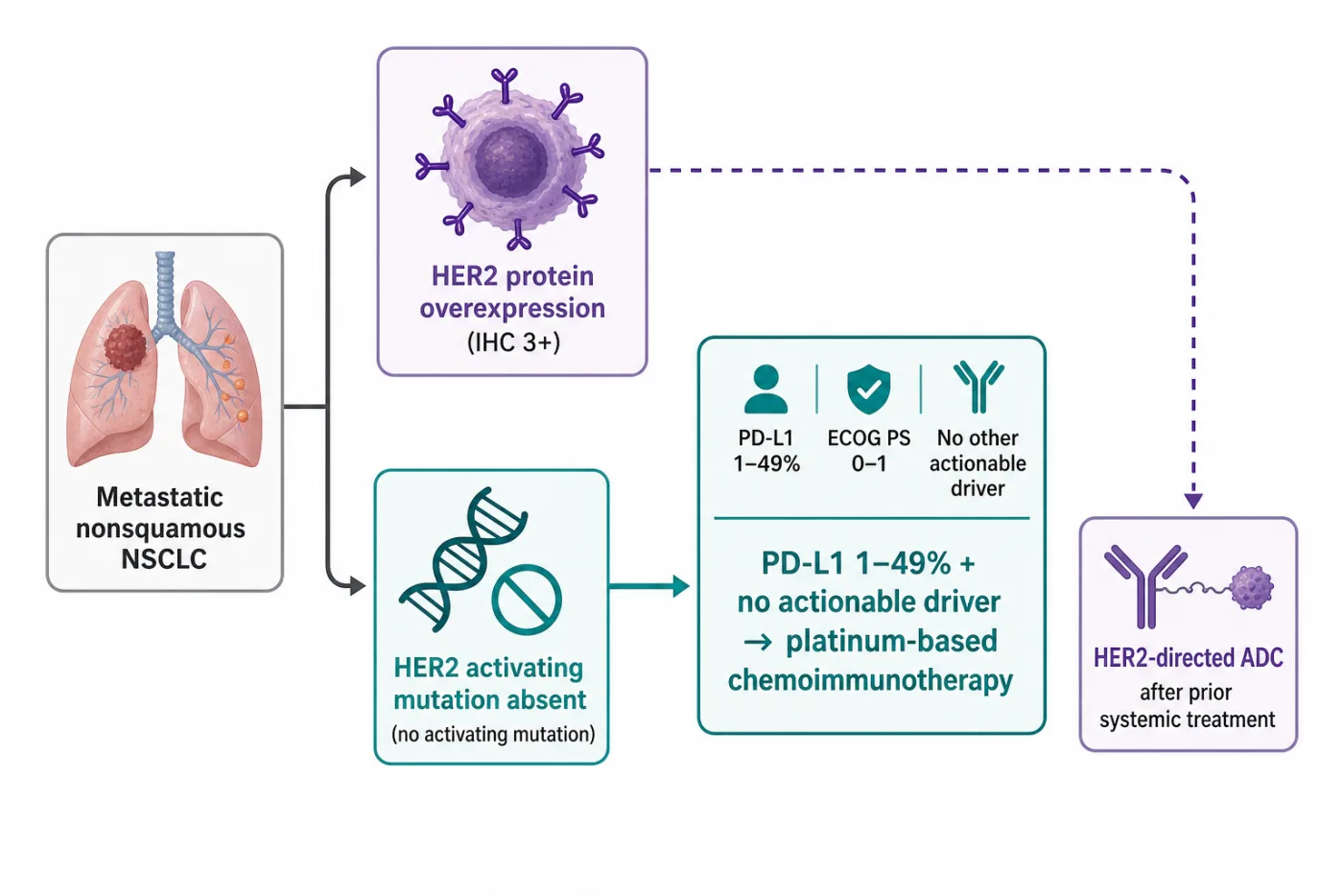
HER2 protein overexpression (IHC 3+) and a HER2 gene mutation are two different biomarkers, and only the mutation changes first-line treatment. A nonsquamous NSCLC with HER2 IHC 3+, no HER2 mutation, and no other driver is treated first line like any driver-negative tumor: for PD-L1 1% to 49% and good performance status, that means platinum-pemetrexed plus pembrolizumab. HER2-directed therapy for the overexpression comes after prior treatment.
HER2 overexpression is defined as 3+ tumor cell staining on IHC, with scoring criteria borrowed from gastric carcinoma. It reflects how much HER2 protein the tumor displays, which is what a HER2-directed antibody-drug conjugate such as fam-trastuzumab deruxtecan (T-DXd) uses. A tyrosine kinase domain mutation is a different lesion: it is an activating change in the HER2 kinase itself, the target of the oral HER2 inhibitors approved for HER2-mutant disease.
For the first-line choice, KEYNOTE-189 randomized 616 patients with previously untreated metastatic nonsquamous NSCLC without sensitizing EGFR or ALK mutations to pemetrexed and a platinum plus pembrolizumab or placebo. Estimated 12-month overall survival was 69.2% versus 49.4% (HR for death 0.49), median progression-free survival was 8.8 versus 4.9 months, and the survival benefit was seen across all PD-L1 categories evaluated, so a PD-L1 of 10% does not remove it.
For T-DXd, the supporting data come from DESTINY-Lung01 cohorts 1 and 1A, a single-arm phase 2 study of patients with HER2 IHC 3+ or 2+ nonsquamous NSCLC. Confirmed response rates were 26.5% at 6.4 mg/kg and 34.1% at 5.4 mg/kg. Grade 3 or worse neutropenia occurred in 24% at 6.4 mg/kg versus none at 5.4 mg/kg, and drug-related interstitial lung disease or pneumonitis in 20% versus 5%.
That study had no comparator and enrolled patients whose disease had relapsed after or was refractory to standard treatment, or for whom no standard treatment was available, so it cannot justify replacing a regimen with a proven survival benefit. The FDA approval for HER2 IHC 3+ solid tumors likewise covers patients who have received prior systemic treatment and have no satisfactory alternative options.
For this patient, nonsquamous histology, PD-L1 of 10%, ECOG 1, normal organ function, and no autoimmune disease leave chemoimmunotherapy as the first-line regimen. If she progresses, T-DXd becomes a subsequent-therapy option because of her HER2 IHC 3+ result.
Separately, HER2-mutant NSCLC is a different situation. For tumors with a HER2 tyrosine kinase domain mutation, zongertinib or sevabertinib are the first-line options listed, with a 77% objective response rate for zongertinib in 74 untreated patients, while T-DXd is used after progression. Her sequencing found no HER2 mutation, so none of this applies. The trap is to treat the IHC 3+ result as a first-line target (B, E).