
Relapsed AML in second remission: next step
Summary
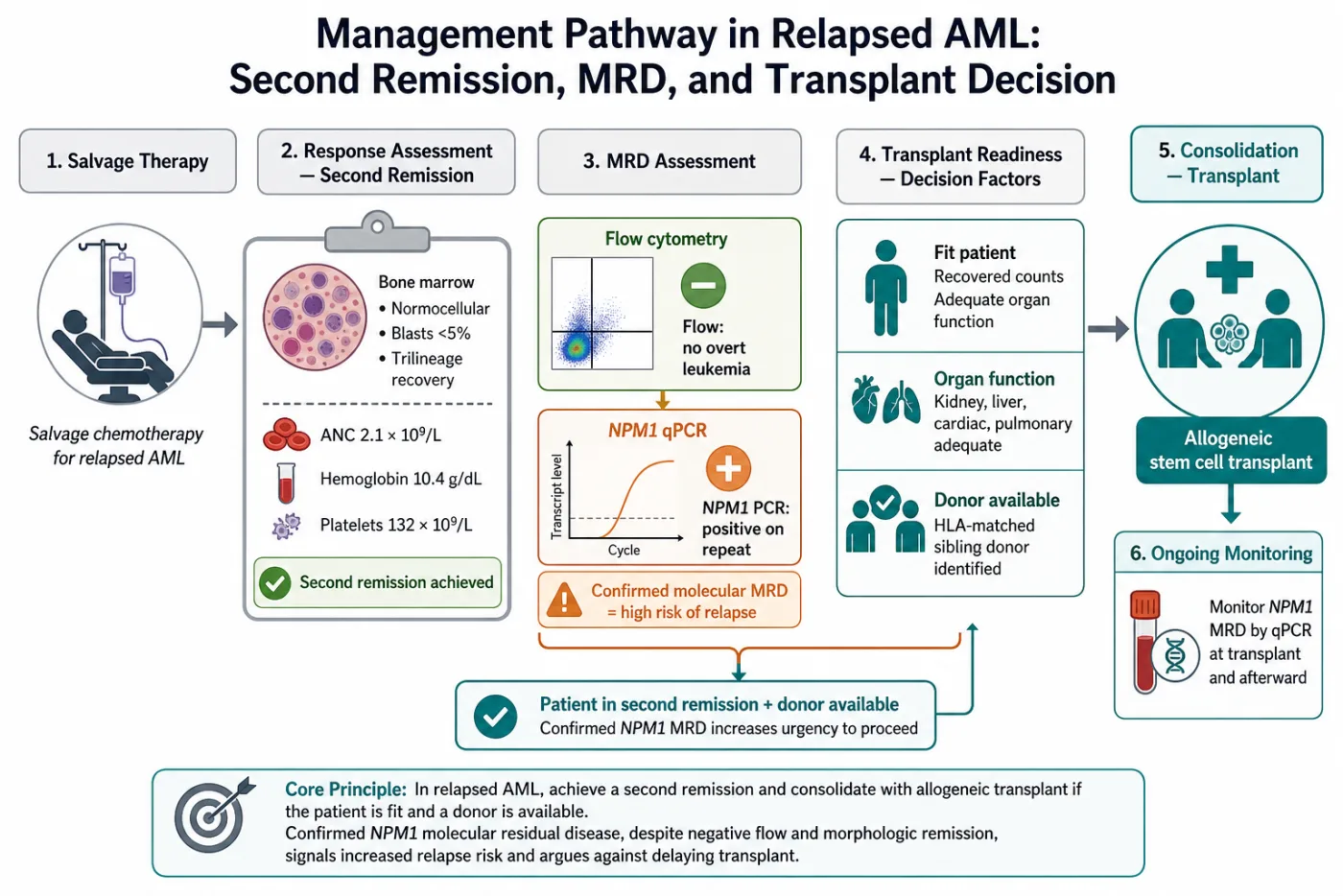
- In relapsed AML, salvage aims for a second remission followed by allogeneic transplant, the only potentially curative option, so the donor search starts at first relapse.
- A fit patient in second remission with a donor proceeds to transplant.
- Quantitative PCR is the recommended method for residual NPM1-mutated disease, and MRD confirmed on repeat testing marks a high risk of relapse even when morphology and flow cytometry are negative.
- Donor lymphocyte infusion is given only after allogeneic transplant, and FLT3 inhibitors need a FLT3 mutation to act on.
Evidence Sources
DNA Sequencing to De
Incorporation of FLT
Incorporation of FLT
National Cancer Rese
DNA Sequencing to De
National Cancer Rese
UK NCRI AML17 and AM
2021 Update on MRD i
Want the rest of the question bank?
The full bank has 2,600+ hematology and oncology board questions like these, with your weak areas tracked as you go. The trial is free for 7 days and needs no card.
These questions are for board preparation and teaching. They are not medical advice for a patient.