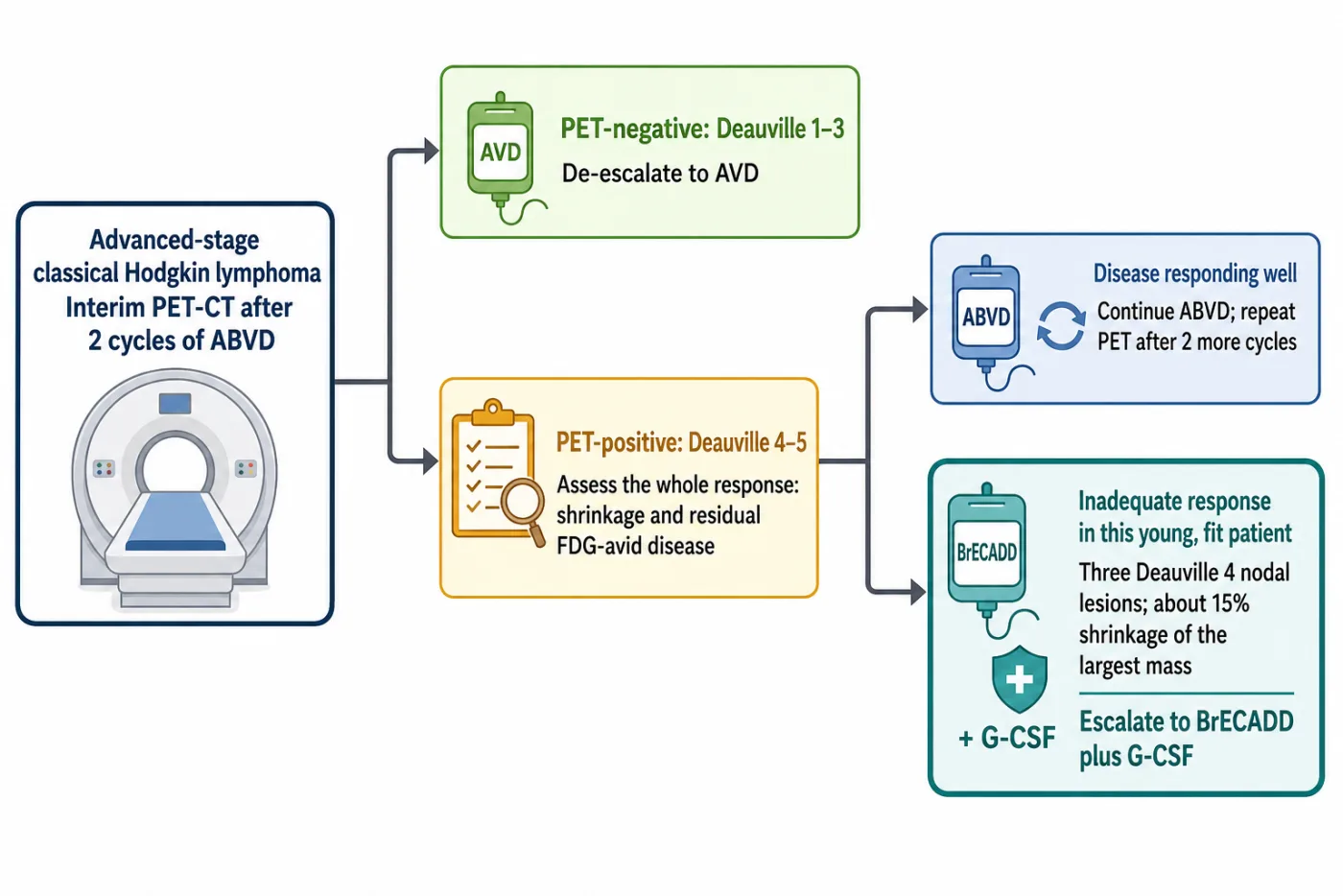
Correct answer — C. Escalate to BrECADD plus G-CSF
Correct. In stage III-IV classical Hodgkin lymphoma, a Deauville 4-5 interim PET after 2 cycles of ABVD does not decide the next step by itself; the whole response does. When the response is inadequate, treatment is escalated to BrECADD plus G-CSF for 3 cycles, followed by restaging.
Deauville 4 and 5 scores are quite variable: uptake can persist in disease that is responding well, and in that case continuing the same chemotherapy and repeating the PET after 2 more cycles is acceptable. So the scan has to be read together with how much the disease has shrunk and how many lesions remain active.
In the nivolumab-AVD arm of SWOG S1826, patients with 3 or more Deauville 4-5 lesions, or a lesion that did not shrink by at least 30% in transverse diameter, were considered to have refractory disease. Those criteria applied at restaging after the 6-cycle nivolumab-AVD course, not at an interim PET after 2 cycles of ABVD, and no numeric threshold is set for an interim PET after ABVD, so they serve here only as a yardstick.
This man has both features, three Deauville 4 lesions and a largest mass that shrank by about 15%, so by that yardstick his response is clearly not a good one, and escalation rather than more ABVD is appropriate.
In the RATHL trial, patients with a positive interim PET (Deauville 4-5) after 2 cycles of ABVD had treatment intensified to escalated BEACOPP. Their 7-year progression-free survival was 65.9% and overall survival 83.2%, lower than the 78.2% and 91.6% for the whole cohort. All PET-positive patients were escalated, so the trial did not compare escalation with continuing ABVD.
Current guidance recommends BrECADD rather than escalated BEACOPP for escalation. In the HD21 trial, 1500 adults aged 60 or younger with advanced-stage disease were randomized to PET-guided BrECADD or escalated BEACOPP; 4-year progression-free survival was 94.3% versus 90.9% (HR 0.66), and treatment-related morbidity was 42% versus 59%.
HD21 tested BrECADD as first-line treatment, not as a switch after ABVD, so its use as escalation has not been formally tested; it is considered reasonable because of its better safety profile than escalated BEACOPP.
Brentuximab vedotin regimens call for caution in patients with neuropathy, and every brentuximab vedotin regimen needs PJP prophylaxis; this man has no neuropathy.
After 3 cycles of BrECADD plus G-CSF he is restaged. A Deauville 1-3 result calls for 1 more cycle of BrECADD, alone or with radiation to initially bulky or remaining PET-positive sites at the end of therapy. A persistent Deauville 4-5 result calls for a biopsy, and a positive biopsy is treated as primary refractory disease.