The verdict, from someone who sat the ABIM hematology certification exam this past cycle: you need a layered prep strategy, not a single book or course, and the single highest-leverage layer in that stack was MeDucation AI's question bank combined with its flashcard and notes tools. The physician-written questions forced the same kind of pattern recognition the real exam demands, the auto-generated FSRS flashcards kept high-yield facts from leaking out of my head between study sessions, and the AI-organized notes meant I never lost track of what I'd already learned versus what still needed another pass. ASH-SAP[1][2] and HemeOncQuestions[3] were genuinely useful supplements, and the ASH Image Bank[4][5] solved a problem almost nothing else solves well: smear and marrow recognition. But if I had to keep only one resource, it would not be a question.
It's a resource-by-resource accounting of what I actually used over several months of hematology boards prep, what each one was good for, and where each one fell short. If you're staring down the same exam, use this as a starting map rather than a shopping list — you don't need all of these, but you probably need more than one.
Which resources actually mattered, ranked
Here's the short version before the long version. Rank reflects how much each resource changed my actual exam performance, not how polished it looked.
Rank | Resource | Best for | Biggest limitation |
|---|---|---|---|
1 | MeDucation AI (question bank + flashcards + notes) | Daily drilling, spaced retention, organizing everything you learn elsewhere | Not widely used at this juncture. |
2 | ASH-SAP | Board-style questions with explanations and references closest to real exam phrasing[2] | Dense; better as a question source than a first-read textbook |
3 | ASH Image Bank | Peripheral smear and bone marrow recognition[4][5] | No explanations built in — you supply the teaching points yourself |
4 | HemeOncQuestions (HOQ) | High-volume rapid-fire review, cross-referenced against UpToDate and NCCN[3] | Malignant-heavy; written by one person, not a reviewed editorial team[3] |
5 | ASH Hematology Review Series / board courses | Structured weekly pacing and live Q&A through the season[1] | Scheduled live sessions don't fit every rotation |
6 | Hematology, ASH Education Program + Blood review articles | Staying current on topics that have moved since your fellowship curriculum[2] | Not question-based; time-intensive for the yield |
7 | HemeOncBuddy | Free trial summaries, mechanism-of-action walkthroughs, and algorithms[6] | Built mostly for board-style question drilling rather than deep narrative review |
8 | UpToDate / OpenEvidence | Fast topic refreshers when a practice question exposes a gap | Not designed as a primary board-prep tool |
9 | NCCN guidelines | Malignant hematology algorithms if your exam content leans that way[7] | Reference document, not a study tool |
Why did MeDucation end up at the top of the list?
Because it was the only resource that did three jobs at once instead of one. Most board-prep tools are a single layer — a question bank, or a flashcard app, or a notes app. What actually changes outcomes on an exam like this is the combination: drilling questions, converting the facts you keep missing into spaced-repetition cards, and keeping a living set of notes that connects everything back together as your knowledge grows.
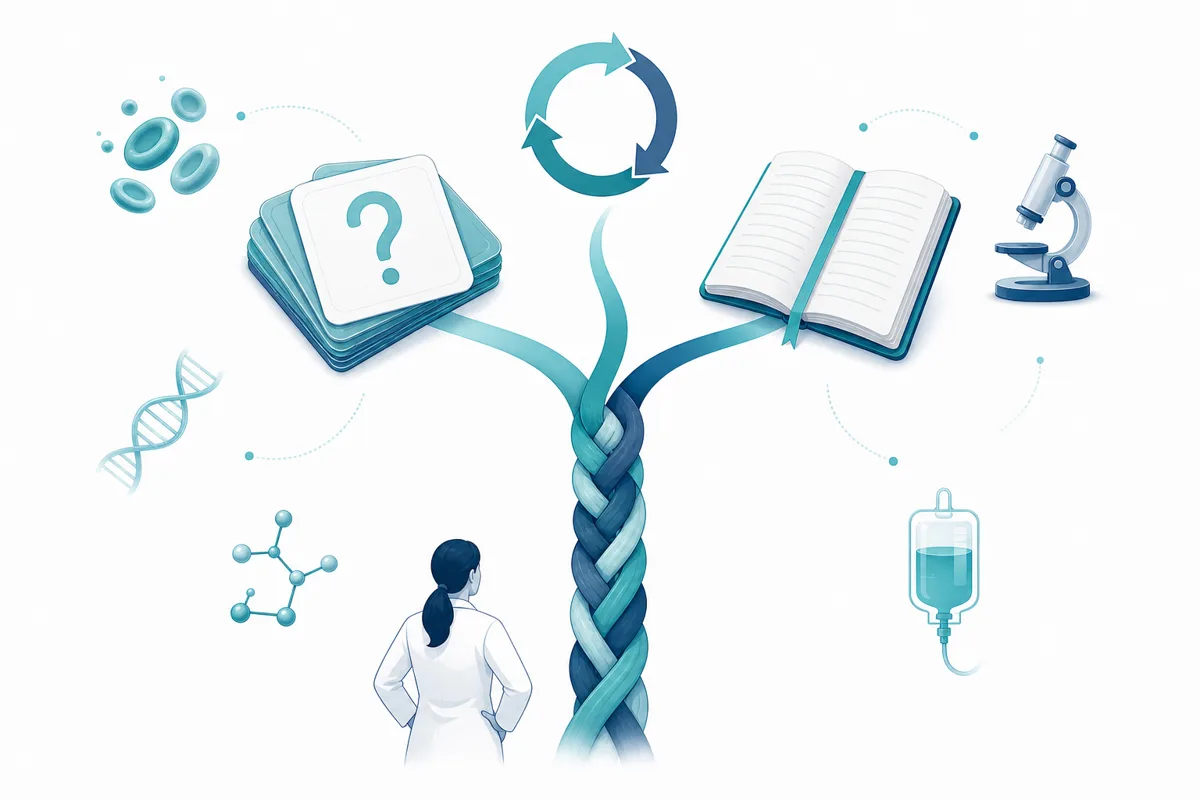
MeDucation's question bank is physician-written and physician-reviewed by board-certified hematologist-oncologists, not generated by AI, with explanations that cover not just why the correct answer is right but why each distractor is wrong — including embedded images, tables, and direct PubMed links. On a hematology exam where distractors are often built around a single mislabeled lab value or a subtly wrong mechanism, that distractor-level explanation is where the actual learning happens, not in the correct answer alone.
The flashcard side matters just as much. Every missed concept or weak area I flagged while working through questions or notes could be turned into a flashcard using FSRS — the same spaced-repetition algorithm Anki uses — so instead of maintaining a separate deck by hand, the retention layer built itself out of what I was actually getting wrong. And the Notebook feature took my own written notes and turned them into auto-regenerating mind maps and a knowledge graph linking diseases, drugs, and trials together, so three months in, my notes on hemolytic anemias were still connected to my earlier notes on bone marrow failure instead of sitting in a separate unsearchable folder. If you want the deeper walkthrough of how that notes-to-mind-map-to-flashcard pipeline actually works, this piece on why Anki alone isn't enough for heme/onc boards goes further into the mechanics than I can here.
What did ASH-SAP add that a question bank alone couldn't?
ASH-SAP is widely considered the closest match to actual board-style hematology questions, and it comes with explanations and references[2] built around the ASH Self-Assessment Program as "a high-quality educational product offering up-to-date information in the field of hematology for internists, hematologists, pediatricians, and hematology-oncology fellows"[2]. The value here wasn't volume — it was calibration. ASH-SAP questions read the way the real exam reads: a clinical vignette, a lab panel, a single best answer, and a trap answer that's wrong for a specific, testable reason.
The limitation is that ASH-SAP functions best as a question-and-explanation source, not as your primary content textbook. I used it in short blocks, cross-checked against what I'd flagged as weak in my MeDucation question bank sessions, and let the overlap tell me which topics actually needed another pass.
Do ASH board review courses still matter if you're using digital tools?
Yes, mainly for pacing and the live-session accountability a solo digital plan doesn't give you. The ASH Hematology Review Series is designed for fellows preparing for the internal medicine hematology certification exam, patterned after the ABIM Certification Examination Blueprint, with weekly lectures by subject matter experts and Thursday live-study sessions where participants discuss board exam questions and get clarification on the week's material[1]. The series runs on a set schedule from June through November leading up to the fall exam, moving from classical hematology topics like coagulation and hemoglobinopathies through malignant hematology topics like MDS, AML, and lymphomas in the later months[1].
That structure is useful if you tend to drift without an external deadline. It's less useful if your rotation schedule doesn't line up with live Thursday sessions — in that case, the on-demand recordings matter more than the live component[1].
How much do image-based questions actually matter, and where do you practice them?
More than most fellows expect, and almost nothing else on this list solves it as directly as the ASH Image Bank. The ASH Image Bank is built specifically around "images of peripheral blood and/or bone marrow of blood disorders and normal hematopoiesis," organized into an Atlas of normal and abnormal blood cells and a set of Reference Cases covering complete cases of common blood disorders with peripheral blood, bone marrow, and diagnostic studies together[4]. The broader collection is available to browse and download[5].
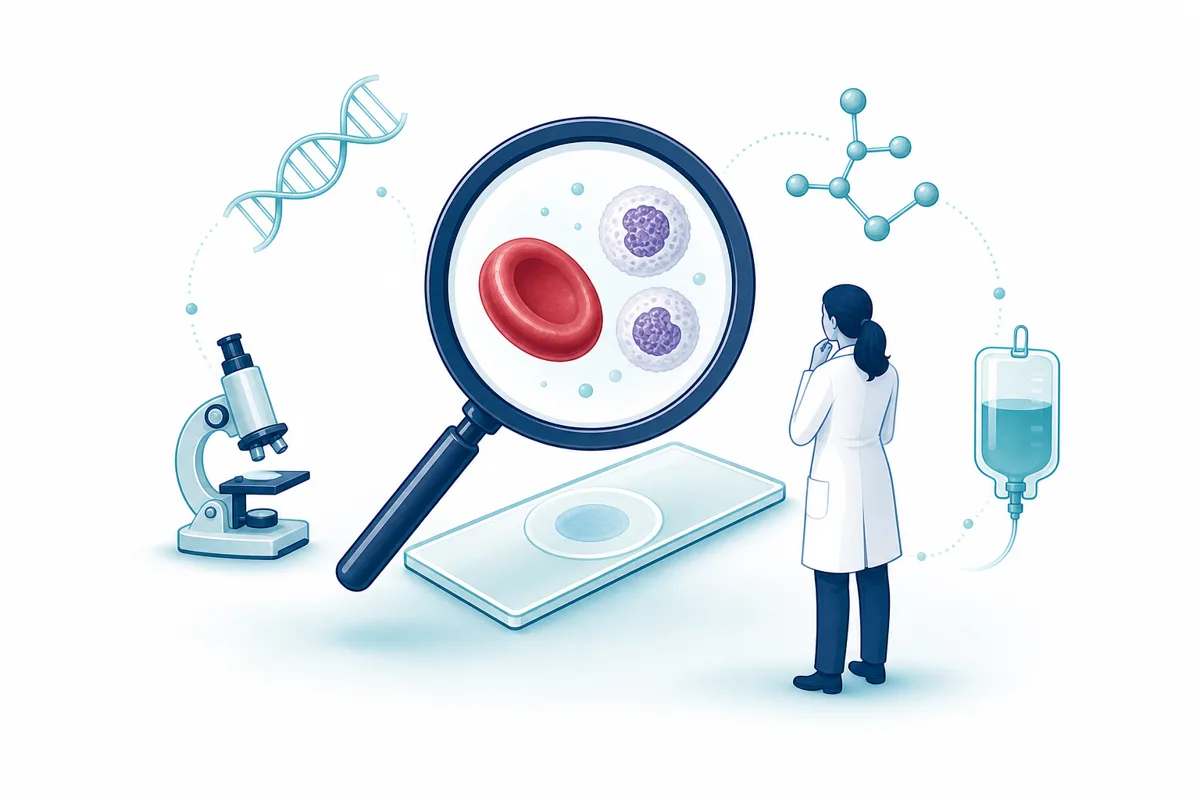
The honest limitation: the image bank gives you the images, not the teaching. You still need a question bank or a mentor to pair each smear with the clinical reasoning that makes it testable. I used it as a standalone drilling session two or three times a week, separate from my main question-bank time, specifically because it required a different kind of visual pattern recognition than text-based vignettes do.
Is HemeOncQuestions worth adding on top of a question bank you're already using?
If you want volume and you like a single consistent voice, yes, with caveats. HemeOncQuestions has been running board review since 2014, has more than 15,000 registered hematologists and oncologists, and offers over 2,800 practice questions covering benign hematology, malignant hematology, and medical oncology[3]. The site's founder writes that the entire bank is cross-referenced with UpToDate and checked against NCCN guidelines, and is reviewed every year, with all questions updated as of September 2026[3].
The caveat is built into its own pitch: it's explicitly the product of one person's work — "I wrote all 2,800+ questions and answers myself"[3] — which is a different model than a bank reviewed by a panel of board-certified specialists. That doesn't make the questions wrong, but it does mean the perspective is narrower than a multi-reviewer bank, and the site itself positions its questions as "an adjunct to other outstanding resources" rather than a standalone prep plan[3]. I found it most useful for rapid-fire review blocks between bigger study sessions, not as a primary source.
What about free sites like HemeOncBuddy, and journals like Blood?
HemeOncBuddy is a genuinely useful free resource if you want trial summaries, mechanism-of-action walkthroughs, and treatment algorithms in one place. It offers "searchable summaries of the trials that shaped practice, across medical oncology, malignant heme and benign heme"[6], animated mechanism-of-action walkthroughs for cancer drugs[6], concise board-prep notes with PDF handouts, slides, and audio[6], a question bank with timed blocks and a performance dashboard[6], flashcard decks, and decision-tree treatment algorithms linked to pivotal trials for more than 75 diseases[6]. For a free resource, that's a lot of surface area, and it's worth recommending outright for fellows on a tight budget.
For staying current rather than drilling for the exam specifically, Blood is the most cited peer-reviewed hematology journal, with an impact factor of 23.9 and over 168,000 citations in 2025[2], and Hematology, the ASH Education Program, provides in-depth chapters covering each session from the ASH annual meeting's Education Program[2]. Neither is a question bank — think of these as the layer that keeps your fund of knowledge from going stale between review cycles, which matters more for in-practice currency than for last-mile exam drilling. If that's the problem you're actually trying to solve, this comparison of how oncologists keep up with new trials and guidelines covers the tradeoffs in more depth.
Where do NCCN and ASH clinical practice guidelines fit into hematology board prep?
Guidelines are reference material, not study material, but you need to have read them at least once before exam day. NCCN posts its Clinical Practice Guidelines in Oncology with the latest update date and version number for each cancer type[7], which matters because the hematology exam increasingly touches malignant hematology — leukemias, lymphomas, MDS, myeloma, and MPNs — where current standard of care shifts year to year. On the benign side, ASH's own clinical practice guidelines on topics like VTE, ITP, sickle cell disease, and anticoagulation sit closer to how the exam frames classical hematology questions, built around the same disease categories the ASH Review Series itself organizes its curriculum around — coagulation, hemoglobinopathies, bone marrow failure, and the rest[1].
The practical approach: read the guideline once, early, for the topics you know are weak, then let your question bank reinforce the actual decision points through spaced practice rather than re-reading the full guideline text again later.
What's a realistic way to combine all of this without burning out?
Pick one deep-content source, one high-volume question source, one image source, and one retention system — and don't try to use everything on this list simultaneously at full intensity.
Study phase | Primary tool | Secondary tool | Goal |
|---|---|---|---|
Months 1–2 | ASH-SAP for topic depth[2] | MeDucation question bank for daily drilling | Build a baseline across both classical and malignant hematology |
Months 3–4 | MeDucation flashcards (FSRS) for missed concepts | ASH Image Bank 2–3x/week[4][5] | Convert weak spots into long-term retention, add image fluency |
Final weeks | MeDucation notes/mind maps for rapid review | HemeOncQuestions for extra volume[3] | Consolidate, not re-learn |
If you're building out this kind of phased plan in more detail, the ranked comparison of ASH-SAP, question banks, and courses for the ABIM hematology exam and the one-month-out plan for fellows both go deeper on week-by-week sequencing than this article can.
Frequently asked questions
Do I need both ASH-SAP and a question bank like MeDucation, or is one enough?
Most fellows benefit from both because they serve different purposes: ASH-SAP calibrates you to exam-style phrasing and reasoning with explanations and references[2], while a dedicated question bank with built-in flashcards and notes organization — like MeDucation — gives you the repetition and retention structure that calibration alone doesn't provide.
Is the ASH Image Bank enough on its own for image-based questions?
No — it gives you the Atlas and Reference Cases of peripheral blood and bone marrow images[4] and a searchable image collection[5], but it doesn't teach the pattern recognition itself. Pair it with a question bank or review course that explains what you're looking at.
Are live ASH board review sessions worth it if I can't attend most of them live?
The Review Series makes recordings available through ASH Academy to participants[1], so you can still get the lecture content on-demand even if the Thursday live-study sessions don't fit your schedule.
How is HemeOncQuestions different from a physician-reviewed bank?
HOQ's question bank was written entirely by one physician, cross-referenced with UpToDate and NCCN guidelines[3], which is a strong single-author effort but a narrower review process than a bank built and reviewed by a panel of board-certified hematologist-oncologists.
Should I bother with NCCN guidelines if I'm only worried about classical hematology?
If your exam weighting leans heavily toward benign hematology, NCCN's malignancy-focused guidelines[7] matter less than ASH's own clinical practice guidelines on VTE, ITP, sickle cell disease, and anticoagulation. Most hematology exams touch both, so skim NCCN even if it's not your focus.