Written by Dr. Roupen Odabashian MD, FRCPC
Hematologist-Oncologist | Founder, MeDucation AI | Updated October 2026
The verdict: no single source keeps a practicing oncologist current anymore, and trying to read everything is how you end up buried in unread updates and still miss the approval that changes Monday's clinic. For a general oncologist, the combination that actually works is one or two broad digests for situational awareness (OncLive or The ASCO Post, skimmed, not read), your own institution's tumor board for the cases you'll actually see, and a filtered personal alert system for the five or six diseases you treat most. For a subspecialist, swap the broad digest time for deeper journal table-of-contents alerts in your one or two diseases and a podcast for the explanation layer, which goes deeper in less breadth. Neither path requires reading every abstract that gets accepted somewhere — at the 2026 ASCO Annual Meeting alone, a record 7,775 abstracts were submitted, with 3,200 selected for presentation[1], and no human reads that volume and also sees patients.
Conflict of interest, up front: I'm a practicing hematologist-oncologist and I founded MeDucation AI, which makes OncoPulse, a free personalized evidence-alert tool, among other paid products. I'll tell you where OncoPulse fits in the stack below and where a free journal alert or a podcast genuinely does the job better.
Every method, ranked
Scored on signal per hour (how much of what you read is actually relevant to your practice), typical delay from publication/approval to you seeing it, cost, and whether it's filtered to the diseases you actually treat.
Method | Signal per hour | Typical delay | Cost | Filtered to your diseases? |
|---|---|---|---|---|
Journal table-of-contents alerts (NEJM, JCO, Lancet Oncology) | Low-moderate | Same day as issue | Often free to subscribe to the alert | No — full issue, every specialty |
OncLive | Moderate | Same day to next day on major approvals | Free to read | No — site-wide news feed |
The ASCO Post | Moderate | Days to weeks (print/digital cadence) | Free subscription for ASCO members and oncology clinicians[2] | No — multidisciplinary, all tumor types |
Medscape Oncology | Low-moderate | Same day to days | Free registration | No — general oncology news feed |
UpToDate "What's New" | Moderate-high | Weeks (post-editorial review) | Pricing not published publicly; check the vendor's site | Partially — organized by topic, not pushed to you |
NCCN guideline updates | High for guideline-level change | Rolling, as panels meet[3] | Free to view guidelines | Yes, if you only check your tumor types |
Oncology podcasts (e.g. ASCO Daily News) | Moderate | Days to a couple weeks after data presented | Free | Partially — episode-by-episode topic choice |
X / LinkedIn | Low (high noise) | Often same-day, sometimes pre-print | Free | No |
Institutional tumor board | High for cases you'll see | Real time for your own patients | Already part of your job | Yes, by definition |
Personalized digests (e.g. OncoPulse) | High | Built to flag new items as they're published | Free | Yes — built around topics you choose |
How many oncology trials and approvals happened last year?
More than most oncologists guess, and the real number is the whole argument for filtering instead of reading everything. Over the full year, the FDA issued more than 50 oncology approvals, with 20 of those landing in just the final three months of the year[4]. That quarter alone included expanded indications for revumenib and the first approval of ziftomenib in NPM1-mutated AML, a new monotherapy indication for daratumumab/hyaluronidase in high-risk smoldering myeloma, a first-line expansion for trastuzumab deruxtecan plus pertuzumab in HER2-positive breast cancer, a new combination approval for belantamab mafodotin, a maintenance-setting approval for lurbinectedin plus atezolizumab in extensive-stage small cell lung cancer, the second small-molecule HER2 inhibitor for NSCLC (sevabertinib), the first PARP inhibitor approval in castration-sensitive prostate cancer, an adjuvant indication for cemiplimab in high-risk cutaneous squamous cell carcinoma, an earlier-stage expansion for pembrolizumab plus enfortumab vedotin in bladder cancer, durvalumab's first approval in gastric/GEJ adenocarcinoma, the first CAR T-cell therapy approved for marginal zone lymphoma (lisocabtagene maraleucel), a new combination for epcoritamab in follicular lymphoma, the first pertuzumab biosimilar, and a subcutaneous reformulation of amivantamab, among several others[4].
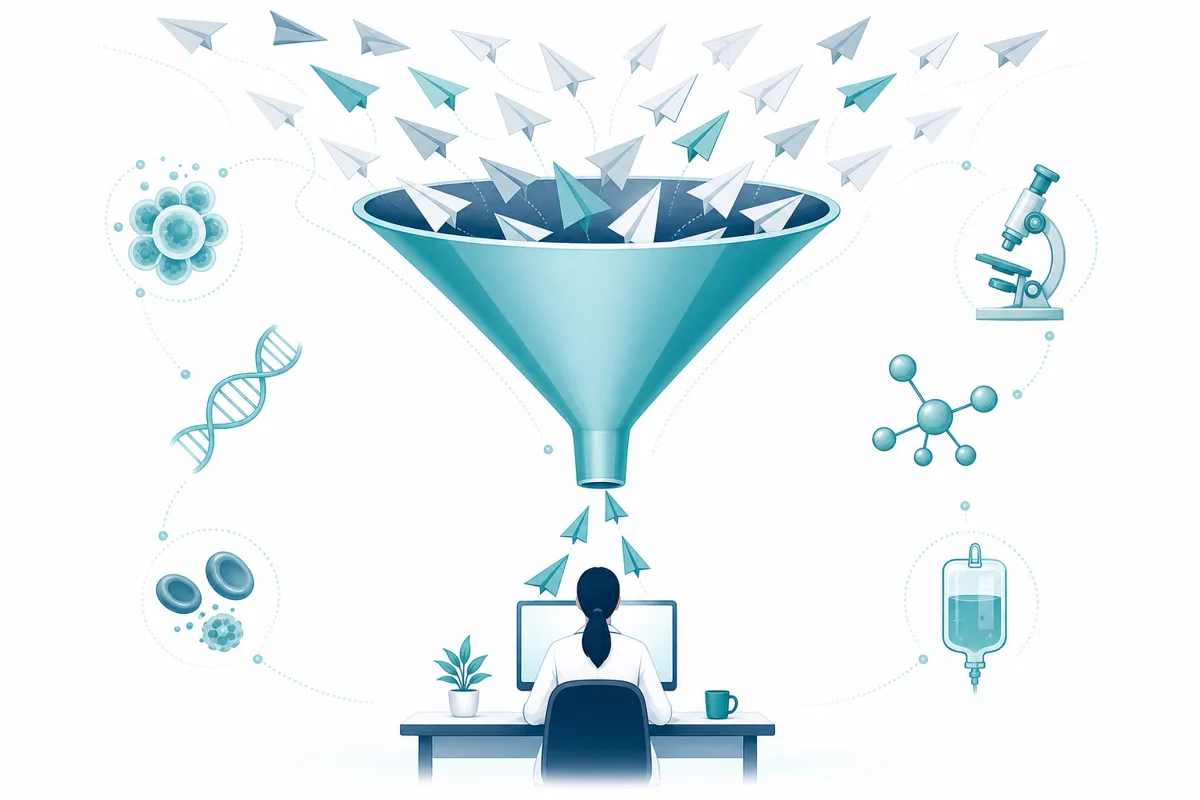
Trial volume tells the same story. A record 7,775 abstracts were submitted to the 2026 ASCO Annual Meeting, of which 3,200 were selected for presentation[1], and the five late-breaking phase 3 trials chosen for the Plenary Session that year spanned colon cancer, head and neck cancer, polycythemia vera, breast cancer, and gastric cancer[1] — five different organ systems in five abstracts, which is a reasonable proxy for how little of any single meeting applies to any single oncologist's practice. Separately, at least 50 oral abstracts and posters that year used circulating tumor DNA for detection or monitoring[1], a sign of where a lot of near-term practice change is concentrated even if it isn't your subspecialty.
Which email alerts are worth keeping?
Keep the ones that are cheap in time and specific to what you treat; cut the ones that are wide and unfiltered. A journal table-of-contents alert for NEJM, JCO, or Lancet Oncology costs almost nothing to receive and lets you scan titles in under two minutes, but it delivers every subspecialty's content to every subscriber — a breast oncologist gets the sarcoma papers too. OncLive and Medscape Oncology are free, fast on major approvals, and reasonable for situational awareness, but they're also unfiltered news feeds, not alerts built around your patient panel. The ASCO Post is distributed free to roughly 30,000 U.S.-based ASCO members and others caring for cancer patients, plus a nightly digest, ASCO Post Evening News, sent to 21,550 U.S.-based and 11,000 international ASCO members[2], which is a reasonable scale check on how many oncologists already treat this as a baseline source rather than a nice-to-have.
The honest trade-off: broad alerts are good for the "did anything huge happen this week" question. They are bad at the "did anything happen in exactly my five diseases" question, because nothing about them is personalized. That gap is exactly where a filtered digest, a podcast built around your rotation, or your own notes system (see our piece on the 2026 numbers behind why nobody can keep up by reading alone) has to fill in.
Do oncology podcasts replace reading?
No, but they're an efficient second pass once you already know roughly what happened. ASCO Daily News Podcast, for instance, runs episodes built around specific practice questions — one recent episode had Dr. Sara Tolaney and Dr. Monty Pal discuss sequencing and combining antibody-drug conjugates in metastatic HER2-positive and triple-negative breast cancer, including how to manage toxicities like ILD and neutropenia[5]; another covered CAR T-cell and bispecific antibody strategy in multiple myeloma with two myeloma specialists[5]; a third covered the rapidly shifting bladder cancer landscape across non-muscle-invasive and advanced disease[5]. That's genuinely useful context layered on top of a headline you've already half-absorbed from an alert or OncLive.
What a podcast doesn't do is tell you that a specific trial was published this week in your disease. Episodes are topic-driven and released on a schedule set by the producer, not triggered by a new approval in your inbox. We cover which shows are actually worth a commute in our ranked guide to oncology and hematology podcasts — use them for depth and context, not for discovery.
What does a personalized digest do that alerts do not?
A personalized digest filters by topic before it reaches your inbox, instead of asking you to filter a full feed yourself after the fact. That's the structural difference between something like OncoPulse and a journal TOC alert or a news site: the filtering happens upstream, once, when you set up the topic, rather than every single week in your head.
What OncoPulse actually filters
OncoPulse is a free AI agent built for practicing oncologists, hematologists, NPs/PAs, and fellows. You create a schedule per topic — a disease or a drug class — choose which content types you want pulled in (published research, clinical trials, FDA approvals, guideline updates), and set the delivery cadence, day, and time. It emails you only new, relevant, non-duplicate evidence for the topics you picked, plus nearby open clinical trials, and the whole setup is fully editable at any point. As the founder put it when OncoPulse launched: "No oncologist can read every FDA approval and every phase 3 readout... the honest math: dozens of label changes a year, hundreds of practice-relevant trials, and a clinic schedule that does not move"[6]. The design intent is narrow and specific — "you create an account, pick the topics you care about, and set up an AI agent that tracks them for you... no feed to scroll, no newsletter you never open"[6].
What it does not do
It does not replace your tumor board, it does not replace reading the primary trial when it matters for a patient in front of you, and it is not a substitute for NCCN guidelines, which remain the authoritative, versioned source — NCCN Clinical Practice Guidelines are posted "with the latest update date and version number"[3] across more than 60 tumor types and related topics[7], and a guideline-level change (like cemiplimab's move to a Category 1 preferred recommendation after the phase III C-POST trial[7]) is the kind of thing you still want to verify at the source, not just from a summary email.
Who it's wrong for
If you want long-form synthesis and editorial framing — the "why this trial matters and what three experts think of it" layer — a digest built to surface new items quickly isn't that, and you're better served by The ASCO Post, OncLive, or a podcast. If you already have an institutional alert system or a librarian-run current-awareness service that does the same filtering, a second parallel system is redundant, not additive. And if you're a subspecialist whose entire practice is two diseases, you may get more value from simply keeping tight journal TOC alerts for those two areas than from any broader tool, digest included.
When do you not need any of this?
You don't need a daily feed, alert, or digest in the weeks you're not seeing new consults in a given disease area — turning a topic off (or never turning it on) is a legitimate strategy, not a gap. You also don't need to personally track a guideline update the week it drops if your institution's tumor board or pharmacy already flags practice-changing NCCN changes as part of routine case review; redundant tracking is wasted time, not diligence. The goal isn't maximum inputs, it's matching input volume to what you'll actually use clinically in the next few weeks — which is the same principle behind building your board exam review around high-yield practice rather than re-reading everything, something we cover in more detail for fellows preparing for the final month before the ABIM Hematology or Medical Oncology exam.
Frequently asked questions
Is it realistic to read every new oncology trial in your subspecialty?
No — even within one meeting, the volume is enormous: 7,775 abstracts were submitted to the 2026 ASCO Annual Meeting, with 3,200 selected for presentation[1], and that's one meeting among many sources of new data each year. Filtering to your diseases, not reading volume, is the realistic goal.
How often does the FDA approve new oncology drugs?
Frequently — more than 50 oncology approvals occurred over the course of one recent year, with 20 of those in the final quarter alone[4], covering everything from new leukemia indications to first-in-class CAR T approvals for rarer lymphomas.
Do I still need NCCN guidelines if I use a digest or news site?
Yes. NCCN Guidelines are the versioned, dated source of record spanning more than 60 tumor types, subtypes, and related clinical topics[7], and any news summary or digest should be treated as a pointer toward checking the actual guideline, not a replacement for it.
Are oncology podcasts a good substitute for reading the primary literature?
They're a good second pass for context and practical management advice — for example, episodes built around sequencing ADCs in breast cancer or managing myeloma toxicities[5] — but they're not timed to new approvals and shouldn't be your only discovery method.
Is OncoPulse free, and who is it built for?
Yes — OncoPulse is free for oncologists, hematologists, NPs, PAs, fellows, and students, built around an editable, topic-based schedule that emails new, relevant, non-duplicate evidence and nearby open trials[6].