
Written by Dr. Roupen Odabashian MD, FRCPC, FASC
Hematologist-Oncologist | Founder, MeDucation AI | Updated February 2026
The verdict: Presenting well at tumor board is a learnable skill, not a personality trait, and most fellows are never actually taught it. Fellows are expected to synthesize a case for an audience of surgeons, radiation oncologists, pathologists, and radiologists — each of whom is listening for different information — and most training programs still leave that skill to osmosis. One survey of respiratory and oncology trainees found they rated their own training programs a 4 out of 10 for how well it prepared them to present at an MDT, and roughly half of trainees in that cohort reported dissatisfaction with their MDT training experience[1]. This article is a practical, specialty-by-specialty guide: what pathology needs from you, what radiation oncology needs, what surgery needs, and how to structure a presentation so the room doesn't have to wait for information you haven't gotten to yet. Conflict of interest: I'm a practicing hematologist-oncologist and founder of MeDucation AI, which builds study and decision-support tools for heme/onc trainees, including a tool relevant to case synthesis discussed below. Nothing here is written to sell that tool — where a free, low-tech fix is the right answer, that's what I'm recommending.
What does a fellow actually need to get right at tumor board?
Four things, in order: structure, audience-awareness, preparation with the imaging and pathology teams in advance, and a clear ask at the end. Get those four right and the clinical knowledge mostly takes care of itself — the failure mode for most fellows isn't not knowing the oncology, it's organizing the case the way they'd organize a progress note instead of the way the room needs to hear it.
Rank | Skill | What it fixes |
|---|---|---|
1 | Front-loading the "ask" and diagnosis before the history | Room no longer waits for information it needs first |
2 | Pre-reading pathology and imaging reports before you present | You can anticipate what pathology and radiology will say |
3 | Knowing what each specialty in the room is actually listening for | You stop presenting a monologue and start running a discussion |
4 | A one-line summary statement at the start | Orients the room before details arrive |
5 | Practicing the format outside of real tumor board | Confidence and fluency before it counts |
Why doesn't fellowship teach this directly?
Because most programs still rely on watching, not doing, and the data say that doesn't work. A systematic review of multidisciplinary oncology education among postgraduate trainees found that trainees across specialties consistently reported limited teaching and limited knowledge of oncology fields outside their own, and endorsed the need for further multidisciplinary training[2]. The same review noted that in multidisciplinary tumor board meetings generally, barriers to meaningful resident participation included time constraints, clinical duties, and a lack of active resident involvement[2]. One underlying reason: tumor board attendance is often passive. As one simulation study of respiratory and oncology trainees put it, simply attending busy meetings "does not support learning in the apprenticeship manner" because trainee participation is too passive to build confidence or presentation skill[1].
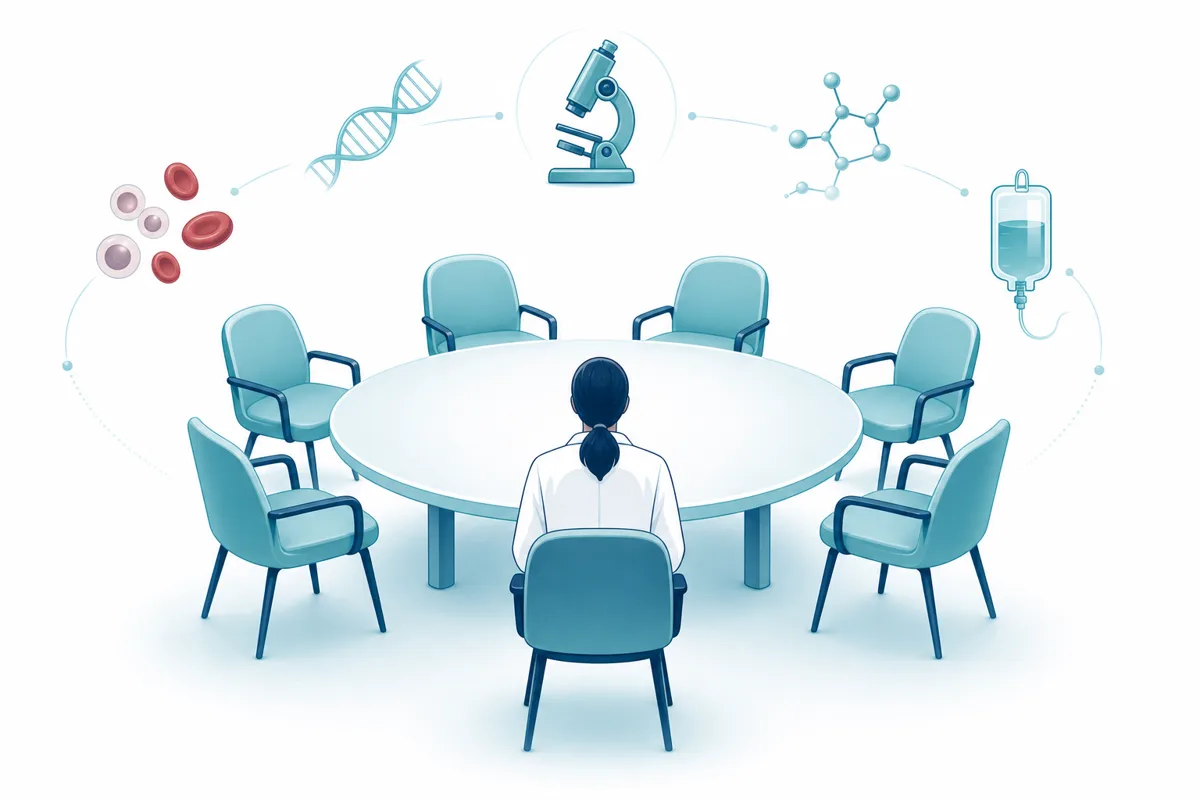
The good news is that when trainees get structured practice, it moves the needle fast. In a simulation where respiratory and oncology trainees played the role of a newly qualified consultant leading case presentations, trainee confidence increased significantly[1], and trainees rated the exercise highly for both usefulness and likelihood of changing their future practice[1]. That's the entire argument for deliberately practicing this skill rather than waiting to pick it up by osmosis in real tumor boards where the stakes are higher and the room is less forgiving.
Measure | Before simulation | After simulation |
|---|---|---|
Rating of current training program's preparation (out of 10) | 4 | —[1] |
Trainee rating of simulation's usefulness (out of 10) | — | 9[1] |
How should you actually structure the presentation?
Lead with the diagnosis and the question, not the chief complaint. Tumor board is not journal club, and it is not a chronological H&P. A room of specialists each listening through a different lens needs orientation before detail, not the other way around. This is the exact failure pattern I've written about before — presenting tumor board the way you'd present journal club leaves the room waiting for information you haven't reached yet. A workable order: one-line summary (age, diagnosis, stage, why this case is here today) → relevant history and comorbidities → imaging findings → pathology findings → the specific question for the room. Everything else is detail that specialists can ask for if they need it.
What does "the ask" actually sound like?
It's a specific question, not "thoughts on this patient." Examples: "Is this patient a surgical candidate given the vascular involvement," or "Does the molecular profile change the sequencing of therapy," or "Should radiation go before or after systemic treatment." A vague prompt gets a vague, unfocused discussion; a specific ask gets a specific answer you can act on.
What does the pathologist actually need from you, and need you to understand from them?
Pathology is often where the entire case stands or falls, and the pathologist is doing far more than confirming a diagnosis label. As one pathologist put it describing the tumor board role: the pathologist "helps the clinicians understand the extent of the diagnosis and the subtype, and even the subclass in some cases, and then the level of expression on the target"[3] — and, more bluntly, "no one has cancer until the pathologist says so," because a tissue diagnosis is what makes the diagnosis of cancer in the first place[3]. Most institutions with tumor boards include a pathologist for exactly this reason[3].
Practically, that means two things for a fellow. First, read the full pathology report before tumor board, not just the diagnosis line — margins, grade, molecular markers, and expression levels are often what the discussion actually turns on. Second, when pathology presents, listen for nuance in subtype and subclass, because that nuance is frequently what changes the treatment recommendation, not the headline diagnosis. One commentary on virtual tumor boards put it plainly for trainees across specialties: you need to be there, in whatever capacity, and interact directly with the clinicians presenting — it isn't a skill you build from behind a monitor[4].
What does radiation oncology need you to bring to the table?
Sequencing information and a clear sense of what surgery and pathology have already determined, because rad onc's recommendation depends on both. In a description of one institution's multidisciplinary tumor board, the typical flow is surgeons presenting the case, followed by imaging review led by radiology, followed by pathology review, and only then a discussion of optimal treatment[5]. The same account notes that the interplay between the surgeon and the pathologist — understanding the nuances of a surgical margin, for example — is often what allows the radiation oncologist and medical oncologist to determine the right adjuvant approach[5]. If you present radiation oncology's question before surgery and pathology have had their say, you're asking for an answer the room doesn't have the inputs to give yet.

There's also a real clinical stake behind getting this interplay right, not just a presentation-etiquette one. Post-mastectomy radiation therapy for breast cancer, for instance, is underutilized in the United States, and its use correlates directly with a surgeon's level of knowledge of it[6]. That's a reminder that the multidisciplinary conversation at tumor board isn't ceremonial — it changes which patients actually get standard-of-care treatment.
What does surgery need you to clarify before the room weighs in?
Resectability and the specific anatomic or vascular question, stated early and precisely. Surgeons in the room are evaluating a narrower, more technical question than "is this cancer treatable" — they're assessing whether this specific tumor, in this specific location, relative to these specific structures, can come out. If your presentation buries the imaging detail that answers that question inside a long narrative history, you'll get asked to repeat it, which costs the room time it doesn't have — one description of a single institution's tumor board notes a full agenda of roughly 30 to 35 patients discussed in about ninety minutes[5], which leaves very little room per case for re-explaining basics.
What should you prepare before you walk in, specialty by specialty?
For pathology: read the full report, not the summary line — grade, margins, molecular markers.
For radiology/surgery: know the specific anatomic question (resectable, borderline, unresectable) before you present it.
For radiation oncology: know what stage the surgical and pathology conversation is at, because sequencing is their central question.
For everyone: prepare questions from radiology and pathology in advance where possible — one account of a successful tumor board model specifically recommends that radiology and pathology colleagues prepare for key cases ahead of time, with specific questions posed in advance[5].
How do you handle a room where specialists disagree?
Name the disagreement out loud and ask for the specific tradeoff, rather than letting the discussion drift. Multidisciplinary tumor boards exist precisely because oncologic decisions often don't have one clean answer — surgery, radiation, and medical oncology are frequently each partially right, and the room's job is to weigh the tradeoff for this particular patient. A clear recommendation at the end of each case discussion is important to the tumor board's success and to continuity of care, even when it's "challenging" to get there[5]. As a fellow, your job isn't to resolve the disagreement yourself — it's to make sure the room actually lands on a clear recommendation rather than ending in ambiguity, by explicitly asking: "so what's the final plan?"
How do you build this skill before it counts in real tumor board?
Through deliberate, structured practice outside of the live meeting, not by hoping real-time exposure teaches it. The evidence on this is specific: trainees who went through a scripted simulation playing the role of the presenting consultant, with faculty playing out the other specialty roles, saw a significant increase in confidence and rated the exercise highly for changing their future practice[1]. Debriefing after each scenario used a simple, validated structure — Describe, Analyse, Apply — moving from what happened, to how effective it was, to how it applies going forward[1]. You can build a version of that same discipline on your own: rehearse the one-line summary and the specific ask before you present, and review your own cases afterward against the same describe-analyse-apply structure.
Where a tool genuinely helps here is in getting organized before you walk into the room — not at the table itself. If you're trying to pull together a complex case with molecular and cytogenetic detail into a structured synthesis before presenting, our broader coverage of fellowship tools and a tool like MeDucation's AI Tumor Board — a multi-agent decision-support tool where a clinician enters a de-identified case and specialist agents (including a disease lead and a clinical pharmacist) produce a staged, citation-backed recommendation — can help you think through the staged plan and the evidence gaps before you present, so you walk in already knowing where the genuine uncertainty is. It's explicitly decision support, not a replacement for the room's own discussion, your attending's judgment, or the patient in front of you — and it only works on de-identified cases.
Frequently Asked Questions
How long should a tumor board presentation actually take?
Published sources don't give a universal time target, but context matters: one institution's tumor board covers roughly 30 to 35 patients in about ninety minutes[5], which works out to well under three minutes per case on average. Match your pace to your program's actual case volume rather than a fixed rule.
Should I present the pathology findings before or after imaging?
Most described tumor board flows put imaging first, led by radiology, followed by pathology review, before the treatment discussion begins[5]. Following that order helps the room build the case in the sequence they're used to hearing it.
What's the single biggest mistake fellows make presenting at tumor board?
Presenting chronologically, like a history and physical, instead of leading with the diagnosis and the specific question. The room is listening for a synthesis, not a narrative, and specialists each need a different piece of information early — surgery needs the anatomic question, rad onc needs the sequencing status, pathology needs to confirm what's already been said about the diagnosis.
Is it normal to feel unprepared for this, even late in fellowship?
Yes — this is a widely reported gap, not an individual failing. Trainees across multiple studies have rated their programs' preparation for multidisciplinary presentation as low, and reported limited formal teaching in oncology fields outside their own[1][2].
Does practicing tumor board presentations in a low-stakes setting actually help?
Yes, based on simulation data: trainee confidence rose significantly after a single structured simulation session, and trainees rated the session highly for usefulness[1].
References
Multidisciplinary Oncology Education Among Postgraduate Trainees: Systematic Review - PMC
A Pathologist’s Crucial Role in Diagnosing Breast Cancer | CancerNetwork
Multidisciplinary Tumor Board: A Single Institution’s Perspective - ILCN.org (ILCN/WCLC)
Multidisciplinary Oncology Education: Going Beyond Tumor Board - PMC