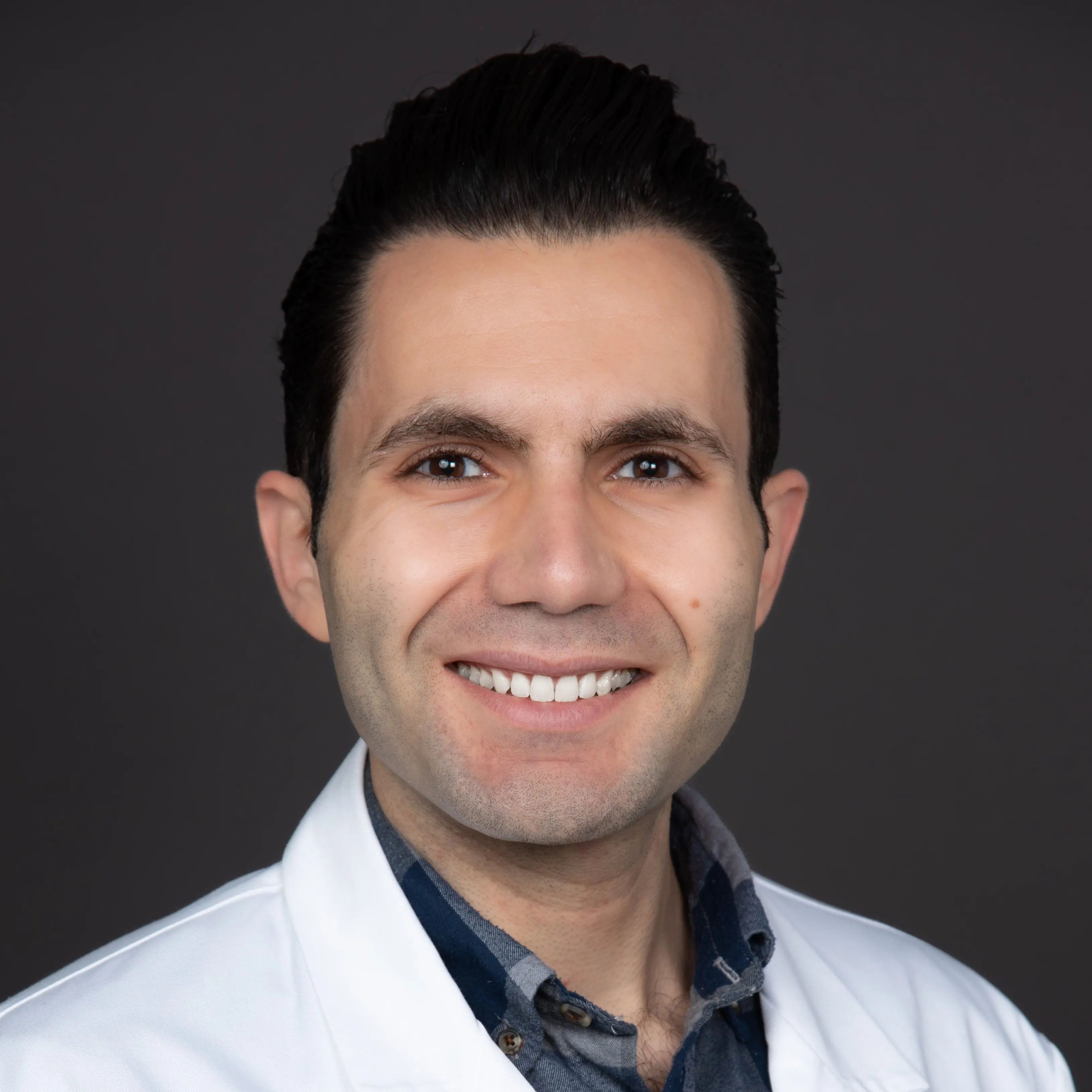


Written by Dr. Roupen Odabashian MD, FRCPC, FASC
Hematologist-Oncologist | Founder, MeDucation AI | Updated August 2026
The money works. Three years of fellowship costs you roughly $350,000 to $700,000 in forgone attending income depending on your comparator, and the compensation gap is wide enough to earn that back in three to eleven years, with most reasonable assumptions landing between four and seven. That is the headline, and it is not the interesting part. The interesting part is that three variables decide whether it works for you: which job you actually would have taken, whether you train at a 501(c)(3) and use Public Service Loan Forgiveness, and whether you go single-boarded at 24 months or combined at 36.

What does the math say in one table?
Question | Answer, August 2026 |
|---|---|
Three-year fellowship stipend | $244,144 national, $245,343 MD Anderson, $335,473 UCLA |
Three-year cost vs a hospitalist job | About $800,549 |
Three-year cost vs general internal medicine | About $676,856 |
Heme/onc attending compensation | Contested. $421,482 to $516,017, a 22 percent spread |
Years to break even, central case | 4.3 vs IM, 6.9 vs hospitalist |
Cost of the third year, 36 months vs 24 | About $379,256 at $464,000 |
Value of making 36 PSLF payments as a trainee | Roughly $113,700 |
Published NPV analysis for heme/onc fellowship | None exists |
Has anyone actually published this math?
No. A targeted PubMed search for a net present value or lifetime earnings analysis specific to heme/onc fellowship returns zero results. That literature is entirely surgical: cardiothoracic surgery has an NPV analysis, pediatric cardiology a preprint, and the AMA's coverage of fellowship ROI draws on a general surgery study that excludes IM subspecialties.[12] The confident numbers circulating in resident lounges come from nowhere.
One caveat. This is nominal, pre-tax and undiscounted, not a true NPV, because any discount rate I picked would be invented rather than sourced. Costs land first and benefits later, so discounting and taxes both push break-even further out.
What does a heme/onc attending actually earn, and why do sources disagree by 22 percent?
There is no single defensible number. Credible sources span $421,482 to $516,017 because they measure different populations, methods and years. Based on my expertise, an academic job could pay $200,000 a year, versus a community job could pay as much as $800,000 a year plus RVUs, depending on where you want to go
Source | Figure | What it measures | Vintage |
|---|---|---|---|
Doximity 2025, "Hematology" line[2] | $421,482 | Self-reported average, regression-adjusted, full-time physicians | 2024 earnings |
Medscape 2026, "Oncology"[1] | $464,000 | Self-reported average total compensation, panel of 5,916 physicians | 2025 earnings |
AMN Healthcare 2025[10] | $490,000 | Average offered starting salary, 1,420 recruiting engagements | 2024 to 2025 recruiting |
Doximity 2025, "Oncology" line[2] | $502,465 | Same method, different specialty label | 2024 earnings |
MGMA via NEJM CareerCenter[3] | $516,017 | Employer-reported median, the only true median verifiable free | 2022 earnings |
Median with 25th and 75th percentiles | Not published | No free primary source publishes one | n/a |

The AMN figure is a methodological artifact, not a finding. Its $490,000 starting salary exceeds Medscape's $464,000 career average, impossible if both measured the same population, since new graduates cannot out-earn the average of all oncologists including themselves. AMN measures salaries offered in actively recruiting markets, which skew rural and underserved; Medscape measures realized pay among survey respondents. Any article presenting both uncritically is wrong.[1][10]
Doximity's "Oncology" and "Hematology" are separate lines, and neither is combined heme/onc. The $81,000 gap between them is unexplained, so quoting $502,465 as the heme/onc number is a defensible-looking error a specialist will catch. In the same report radiation oncology sits at $588,678 and pediatric hematology and oncology at $255,733, among the five lowest-paid specialties despite comparable training length.[2]
MGMA has the best methodology and the worst vintage. Employer-reported payroll beats self-report and runs higher, but it is four years stale and the 2025 edition is paywalled.[3]
Is the academic versus community oncology gap published anywhere?
No, and this is where these articles usually fabricate. BUT IT IS REAL!!! I checked Medscape, Doximity, MGMA, ASCO and AAMC: none publishes an academic versus community split for hematologists and oncologists.[1] Based on my experience: the gap is huge!
Three labeled proxies. Medscape's roughly 2018 report put self-employed oncologists at $471,000 against employed at $330,000.[1] Hospitalists, the only IM-adjacent field with a measured split, run $355,307 nonacademic against $303,624 academic.[4] Doximity's oncology metro table runs from $495,532 in Rochester, Minnesota to $358,782 in Durham-Chapel Hill, its three lowest metros all academically dominated.[2] Suggestive of a discount, not a measurement.
Do the surveys understate what oncologists earn?
Probably. Gottlieb and colleagues, using linked tax and administrative data rather than surveys, found US physicians average about $350,000 a year and that one quarter of physician earnings comes from business income systematically underreported in survey data.[12] Every figure above is therefore likely a floor, and the understatement should be largest in private-practice-heavy community oncology. See also my guide to what hematology-oncology physicians actually make.
What do you earn during fellowship, and how much does geography change it?
About $244,144 across three years nationally, a number close to meaningless without a geography caveat: the same training stage pays $30,827 more per year at one institution than another.
Program | PGY-4 | PGY-5 | PGY-6 | Three-year total |
|---|---|---|---|---|
AAMC national average, July 1, 2025[5] | $77,593 | $81,807 | $84,744 | $244,144 |
MD Anderson, AY 2026 to 2027[5] | $78,917 | $81,776 | $84,650 | $245,343 |
WashU and Barnes-Jewish, AY 2026 to 2027[5] | $80,895 | $84,439 | $88,091 | $253,425 |
UCLA, effective September 1, 2026[5] | $108,102 | $111,894 | $115,477 | $335,473 |

UCLA's trainees are unionized under CIR-SEIU, and UCLA adds an $8,000 per year Resident Enhancement Fund, taking its three-year total to roughly $359,473. Against MD Anderson that is a swing of about $90,130 before the fund and $114,130 after. Cost of living eats part of that, not all. The AAMC figures are also unweighted averages, and its own PGY-1 median of $66,986 sits below its unweighted average of $68,166.[5][7] Any "the typical fellow earns" claim that does not name a city tells you nothing.
Which comparator should you use, and why does it change the answer?
Use the hospitalist number, not general internal medicine. The resident who skips fellowship does not become a general internist in a clinic; in 2026 they become a hospitalist, and hospitalists out-earn general IM in every source I checked. The general IM figure inflates the apparent value of fellowship by roughly $124,000.
Comparator | Annual figure | Three-year earnings | Less stipend | Opportunity cost |
|---|---|---|---|---|
AMN starting salary, internal medicine[10] | $290,000 | $870,000 | $244,144 | $625,856 |
Medscape 2026, internal medicine[1] | $307,000 | $921,000 | $244,144 | $676,856 |
Doximity 2025, internal medicine[2] | $326,116 | $978,348 | $244,144 | $734,204 |
Today's Hospitalist, all hospitalists[4] | $348,231 | $1,044,693 | $244,144 | $800,549 |
So the honest range is $626,000 to $801,000 pre-tax, hospitalist at the top. That mean includes about $43,000 a year of bonus and incentive pay and comes from a self-selected survey with an undisclosed respondent count. It is still the best free figure available: the Society of Hospital Medicine's 2025 report gives no dollar figures outside its paywall.[4]
How many years does it take to break even?
Between roughly three and eleven, central estimate four to seven. The first table pairs each heme/onc figure only with the comparator from the same survey, same year, same method, the only internally clean arithmetic.

Matched pair (same source, same year) | Heme/onc | Comparator | Annual gap | Opportunity cost | Years to break even |
|---|---|---|---|---|---|
AMN 2025 starting salaries[10] | $490,000 | IM $290,000 | $200,000 | $625,856 | 3.1 |
Doximity 2025, "Oncology" line[2] | $502,465 | IM $326,116 | $176,349 | $734,204 | 4.2 |
Medscape 2026[1] | $464,000 | IM $307,000 | $157,000 | $676,856 | 4.3 |
Doximity 2025, "Hematology" line[2] | $421,482 | IM $326,116 | $95,366 | $734,204 | 7.7 |
Now the comparator you would actually take. No hospitalist figure exists inside Medscape, Doximity or MGMA, so this table crosses sources. Read it as sensitivity analysis, not as measured pairs.
Heme/onc assumption | Gap vs hospitalist mean $348,231[4] | Years to recoup $800,549 |
|---|---|---|
Low: $421,482 Doximity[2] | $73,251 | 10.9 |
Central: $464,000 Medscape[1] | $115,769 | 6.9 |
High: $516,017 MGMA, 2022[3] | $167,786 | 4.8 |
The spread between 4.8 and 10.9 years is not noise you can average away. It is the difference between an obviously good decision and one needing non-financial reasons to justify. A well-paid community job in an underserved market puts you at the top of that range; an academic hematology role in a saturated metro puts you at the bottom.

What does the third year of fellowship actually cost you?
About $379,256 pre-tax, the largest discretionary line item in the calculation. The ACGME text is explicit: combined hematology and medical oncology must be 36 months, medical oncology alone 24 months, hematology alone 24 months, the last effective July 1, 2026.[6]
Attending compensation assumption | Year-three income forgone | PGY-6 stipend[5] | Net cost of the third year |
|---|---|---|---|
$421,482, low[2] | $421,482 | $84,744 | $336,738 |
$464,000, central[1] | $464,000 | $84,744 | $379,256 |
$516,017, high[3] | $516,017 | $84,744 | $431,273 |
I am not telling you to go single-boarded. Dual boards buy scope of practice and most community jobs expect both. But decide with that $337,000 to $431,000 price tag in front of you rather than defaulting into it. ACGME accredits hematology-only and medical-oncology-only programs at 24 months each, which is where that year comes from.[6]
How do the 2025 and 2026 student loan changes rewrite the answer?
More than the compensation numbers do, and this is where standard advice is most out of date. The One Big Beautiful Bill Act was signed July 4, 2025 and the implementing final rule published May 1, 2026. If an article on this mentions SAVE, throw it away: SAVE is gone, and ICR and PAYE end no later than July 1, 2028.[8] What changed:
Grad PLUS is eliminated for loans first disbursed on or after July 1, 2026. Existing borrowers are grandfathered.
New professional-student limits are $50,000 per year and $200,000 aggregate inside a $257,500 lifetime cap. Against a median four-year private cost of attendance of $408,150, that gap gets filled privately.[7]
The "professional degree" definition is unsettled. On June 24, 2026 the US District Court for DC preliminarily stayed part of it, moving programs in and out of those limits.
The Repayment Assistance Plan (RAP) charges 1 to 10 percent of adjusted gross income divided by 12, minus $50 per dependent, minimum $10 per month, no cap, forgiveness at 30 years. Uncapped means you can pay more under RAP than under Standard.
Anyone with a loan first disbursed on or after July 1, 2026 may use only RAP or the Tiered Standard Plan. The 20-year IBR track is closed to them.
The Tiered Standard Plan does not qualify for PSLF or TEPSLF. Choosing it silently forfeits forgiveness, making RAP the only PSLF-viable plan for new borrowers.
IDR forgiveness may be taxable. RAP's 30-year forgiveness may generate a tax bill. PSLF forgiveness does not.
What happens to your loans while you are a fellow?
They grow, every month, for all three years. Direct Loans accrue daily interest, including in deferment and forbearance, and under any income-driven plan the payment can be smaller than the accruing interest. That is negative amortization, and the unpaid interest stays yours until forgiveness or payoff.[8]
The table assumes a blended 8 percent, just under the 8.07 percent unsubsidized rate for academic year 2026 to 2027 and atop the 5.28 to 8.08 percent band covering 2021 through 2025, an $85,000 fellowship AGI, and, generously, that you pay RAP's full 10 percent ceiling. Capitalization rules are now narrow, so unpaid interest accrues without compounding.[8]
Starting debt | Interest at 8 percent | Maximum RAP payment at $85,000 AGI | Annual shortfall | Unpaid interest, 3 years | Balance at graduation |
|---|---|---|---|---|---|
$0, or 30 percent of graduates[7] | $0 | n/a | $0 | $0 | $0 |
$215,000, median borrower[7] | $17,200 | $8,500 | $8,700 | $26,100 | about $241,100 |
$250,000, private school median[7] | $20,000 | $8,500 | $11,500 | $34,500 | about $284,500 |
$300,000, the 28 percent tail[7] | $24,000 | $8,500 | $15,500 | $46,500 | about $346,500 |

The first row matters more than people expect. Per the AAMC Fact Card for the Class of 2025, 70 percent of graduates carried education debt, meaning 30 percent graduated with none. Any article assuming universal $215,000 debt overstates the burden for nearly a third of its readers. Among borrowers the median owes $215,000, 28 percent owe at least $300,000, and 65 percent plan to use a forgiveness program.[7] No one publishes debt levels for heme/onc fellows specifically.
Is PSLF still the strongest financial argument for fellowship?
Yes, and it survives the overhaul. PSLF requires 120 qualifying monthly payments, not necessarily consecutive, while working at least 30 hours per week for a government or 501(c)(3) employer. Fellowship at a nonprofit academic center qualifies, so three years delivers 36 of those 120 at trainee-level amounts.[8]
That is the mechanism people miss when they frame fellowship as lost income. At the same 10 percent ceiling, three years of payments on an $85,000 fellowship AGI costs about $25,500; on a $464,000 attending AGI, about $139,200. Making those 36 payments as a fellow is worth roughly $113,700 you never pay, toward forgiveness that is not taxable. AAMC's own scenario: $215,000 on IBR through residency and seven post-residency years at $170,000 with PSLF gives $130,000 repaid and $294,000 forgiven, against a separate AAMC scenario, on RAP at a $200,000 starting salary with no PSLF, of $480,000 repaid over 21 years.[7]

Three cautions. For post-July 2026 borrowers on RAP, only payments made on time and in full count, so a fellow who forbears earns no credit, with economic hardship deferment the one exception. Parent PLUS loans and consolidations including them cannot continue to qualify. Most important: a court order currently blocks enforcement of PSLF changes scheduled for July 1, 2026, per studentaid.gov as of August 2026. Litigation posture changes, so verify it yourself.[8]
Is heme/onc still realistic to get into?
Less than it was two years ago. In 2026 the NRMP Specialties Matching Service offered 809 hematology and oncology positions across 212 programs, filled 805 for a 99.5 percent fill rate, and left 382 of 1,187 applicants unmatched, a 67.8 percent applicant match rate against an all-subspecialty fill rate of 84.4 percent.[9]
Summarizing rather than reproducing NRMP's tables: from 2022 to 2026 positions grew 22 percent while applicants grew 33 percent, the applicant match rate fell from 76.1 percent in 2024 to 67.8 percent, and applicants per position rose from 1.3 to 1.5.[9] Harder to enter, still among the most reliably filled subspecialties. On whether to apply, see the non-financial case for heme/onc fellowship.
Does the job market support these salary numbers?
Yes. ASCO's data show absolute growth and per-capita decline at once, which is what creates the recruiting premium.[11]
Workforce measure | Finding |
|---|---|
Oncologists billing Medicare, 2014 to 2024 | 12,267 rising to 14,547 |
Oncologists per 100,000 aged 55 and older | 15.9 falling to 14.9 |
States with fewer oncologists per capita than 2014 | 38 |
Population 55 and older in at-risk counties | 68 percent |
Non-metro demand met by 2037 | 29 percent, against 102 percent in metro areas |
Kirkwood and colleagues, in JCO Oncology Practice in 2025: "Gaps in oncologist coverage across the country exist, especially among rural populations and those with high cancer burden and socioeconomic risk." Co-author Manali Patel of Stanford said in ASCO's release that "Our data identifies significant 'cancer care deserts,' particularly in rural communities."[11] The part that matters for your wallet: early-career oncologists are half as likely as late-career oncologists to practice in non-metropolitan or high-mortality areas. The shortage sits where new graduates will not go, which is why AMN's $490,000 measures what a supply-constrained market pays someone willing to move.[10][11]

So what decides whether this works for you?

Your real comparator. The hospitalist job you would have signed, not "internal medicine" in the abstract. Worth about $124,000 and more than two years of break-even.
PSLF eligibility. A 501(c)(3) employer on RAP rather than Tiered Standard: roughly $113,700, and three years of a 10-year clock on day one.
24 months versus 36. Between $337,000 and $431,000 pre-tax, decided by a checkbox on your application.
Where you train and land. Stipend geography swings three-year earnings by roughly $90,000; attending geography by $136,750 across metros.
Everything else is rounding.

Should the money be the reason?
No, and this is the only paragraph of that you will get from me. A break-even of four to eleven years makes the financial case real but not decisive, and nowhere near strong enough to carry you through the parts of this job that have nothing to do with money. Arithmetic is not what gets you through a clinic day where three conversations go badly. Run the numbers anyway, because nobody else has. Then decide on the work.
You have to understand that every job has its own positives and negatives. In this article, we answer only the money piece, but there is so much more beyond that when choosing a career

Frequently asked questions
How much money do you lose doing a heme/onc fellowship?
Roughly $626,000 to $801,000 in pre-tax forgone income over three years. Against the Medscape 2026 internal medicine average of $307,000 it is about $676,856; against the Today's Hospitalist mean of $348,231, about $800,549. Both already credit the $244,144 you earn in stipend.
How long does it take to break even after a hematology-oncology fellowship?
Between about 3.1 and 10.9 years depending on source and comparator. Medscape's $464,000 against internal medicine at $307,000 breaks even at 4.3 years; the same $464,000 against the hospitalist mean of $348,231 takes 6.9 years. These are nominal and undiscounted, so real break-even is longer.
Does fellowship count toward Public Service Loan Forgiveness?
Yes. Fellowship at a government or 501(c)(3) employer counts, so three years delivers 36 of the 120 required payments at trainee-level amounts, worth roughly $113,700 against making them on an attending income. Two warnings: the Tiered Standard Plan does not qualify, and as of August 2026 a court order blocks PSLF changes scheduled for July 1, 2026.
Is a 24-month single-boarded fellowship a better financial decision than 36 months?
Financially yes, by a lot. ACGME requires 36 months for combined hematology and medical oncology and 24 months for either alone. That third year costs about $336,738 to $431,273 pre-tax, a PGY-6 stipend of $84,744 against attending pay of $421,482 to $516,017. Dual boards buy scope most community jobs expect, so it is a trade, not a free win.
What is the average hematologist-oncologist salary in 2026?
There is no single defensible number. Credible sources span $421,482 to $516,017, a 22 percent spread, because they measure different populations. Medscape 2026 puts oncology at $464,000; Doximity lists Oncology at $502,465 and Hematology at $421,482 separately; MGMA's median was $516,017 on 2022 data; AMN's average offered starting salary is $490,000.
References
Medscape 2026 reports via Becker's: oncologist compensation falls 2 percent; 29 specialties ranked by compensation. Medscape's pages are login-walled. Historical employment split: earlier oncologist report.
Doximity. 2025 Physician Compensation Report. Averages, 37,000 surveys collected in 2024.
MGMA 2023 Provider Compensation Data Report via NEJM CareerCenter. Physician specialty compensation trends; the 2025 MGMA report is paywalled.
Today's Hospitalist Compensation and Career Survey: Factors affecting hospitalist pay; the 2025 State of Hospital Medicine report gives no public figures.
AAMC Survey of Resident/Fellow Stipends and Benefits 2025, via the AMA and the AAMC. Institutional scales: UT MD Anderson Cancer Center, Washington University GME Consortium, UCLA.
ACGME Program Requirements: Hematology and Medical Oncology, 36 months; Medical Oncology, 24 months; Hematology, 24 months, effective July 1, 2026.
AAMC. Medical Student Education Debt, Costs, and Loan Repayment Fact Card, Class of 2025 (PDF).
US Department of Education, Federal Student Aid: interest rates and fees; income-driven repayment plans; Public Service Loan Forgiveness; program updates; implementing rule in the Federal Register, May 1, 2026.
National Resident Matching Program. Results and Data: Specialties Matching Service, 2026 Appointment Year and the news release, corroborated by the AMA. Summarized rather than reproduced.
AMN Healthcare, 2025 Review of Physician and Advanced Practitioner Recruiting Incentives and its specialty table; SullivanCotter 2025 data via Becker's.
Kirkwood MK, Balogh EP, Accordino MK, et al. "Where Have We Been and Where Are We Going? The State of the Hematology and Medical Oncologist Workforce in America." JCO Oncology Practice. 2025;21(12):1775 to 1785. Free full text; ASCO news release, October 7, 2025.
Earnings measurement and prior fellowship ROI literature. Gottlieb JD, Polyakova M, Rinz K, et al. "Who Values Human Capitalists' Human Capital? The Earnings and Labor Supply of U.S. Physicians." NBER Working Paper 31469, 2023. Existing fellowship NPV work is surgical: a cardiothoracic surgery analysis, a pediatric cardiology preprint, and the AMA's coverage of a general surgery study.
Related: what to expect in your first year as a heme/onc fellow.