Written by Dr. Roupen Odabashian MD, FRCPC
Hematologist-Oncologist | Founder, MeDucation AI | Updated October 2026
Conflict of interest, up front: I'm a practicing hematologist-oncologist and I founded MeDucation AI, which sells a physician-written heme/onc question bank and other study tools built for fellows, not applicants. Nothing in this article is about selling you fellowship-application help — we don't offer that product. I'm writing this because I went through this match, and because the publicly available data on it is scattered across NRMP and AAMC pages that most residents never read closely.
Where does the heme/onc match rank against other IM subspecialties?

Subspecialty | Certified positions | Fill rate |
|---|---|---|
Cardiovascular Disease | 1,347 | 100%[1][2] |
Hematology and Oncology | 809 | 99.5%[1][2] |
Gastroenterology | 759 | 99.5%[1][2] |
Pulmonary/Critical Care | 844 | 98.8%[1][2] |
Clinical Cardiac Electrophysiology | 150 | 98%[1][2] |
Source: NRMP, 2025 Medicine and Pediatric Specialties Match results[1].
How competitive is hematology oncology fellowship?
Very — but "competitive" means something specific here: almost every position fills, and unmatched applicants carry the cost. Of the 8,085 applicants who preferred an internal medicine subspecialty track in the broader Match, 73.8% matched into an internal medicine subspecialty, 0.3% matched into a different specialty group, and 25.9% did not match anywhere[2]. That's roughly one in four applicants to IM subspecialties overall leaving without a position, and heme/onc's near-total fill rate means the shortfall is concentrated among applicants who aimed at competitive specialties without a strong-enough file.
Match rates differ sharply by applicant type. Of active applicants across the whole Medicine and Pediatric Specialties Match, 89% of U.S. MD graduates matched, compared with 78% of U.S. DO graduates, 70% of non-U.S. citizen IMGs, and 65% of U.S. citizen IMGs[2]. Those are match rates to any subspecialty position, not heme/onc specifically, but they're the best proxy available for how applicant type correlates with outcome in this match.
What does the 2026 cycle timeline actually look like?
The fellowship match runs on a fixed annual calendar set by ERAS and the NRMP, and heme/onc is a July Application Cycle specialty[3], meaning appointments begin the following July. The table below lays out the sequence for the cycle leading into the 2026 appointment year, each milestone drawn from NRMP and AAMC's own pages.
Milestone | What happens |
|---|---|
Program signaling opens | Applicants to participating programs submit signals of interest as part of ERAS |
ERAS application cycle (July specialty) | Hematology and Medical Oncology (Internal Medicine) applications open and programs begin reviewing files |
Interview season | Participating programs review signals and invite applicants to interview |
Rank order list certification | Programs and applicants submit certified rank order lists to NRMP's Specialties Matching Service |
Match results released | NRMP releases Medicine and Pediatric Specialties Match results and statistics report |
What do programs actually weigh?
The single most heavily weighted factor across specialties, by programs' own report, is letters of recommendation in the fellowship specialty, followed closely by residency performance evaluations and the reputation of the residency program[4]. This data comes from NRMP's program director survey of fellowship programs across all specialties, not heme/onc alone, but it's the most direct look available at how program directors say they actually screen and rank applicants.
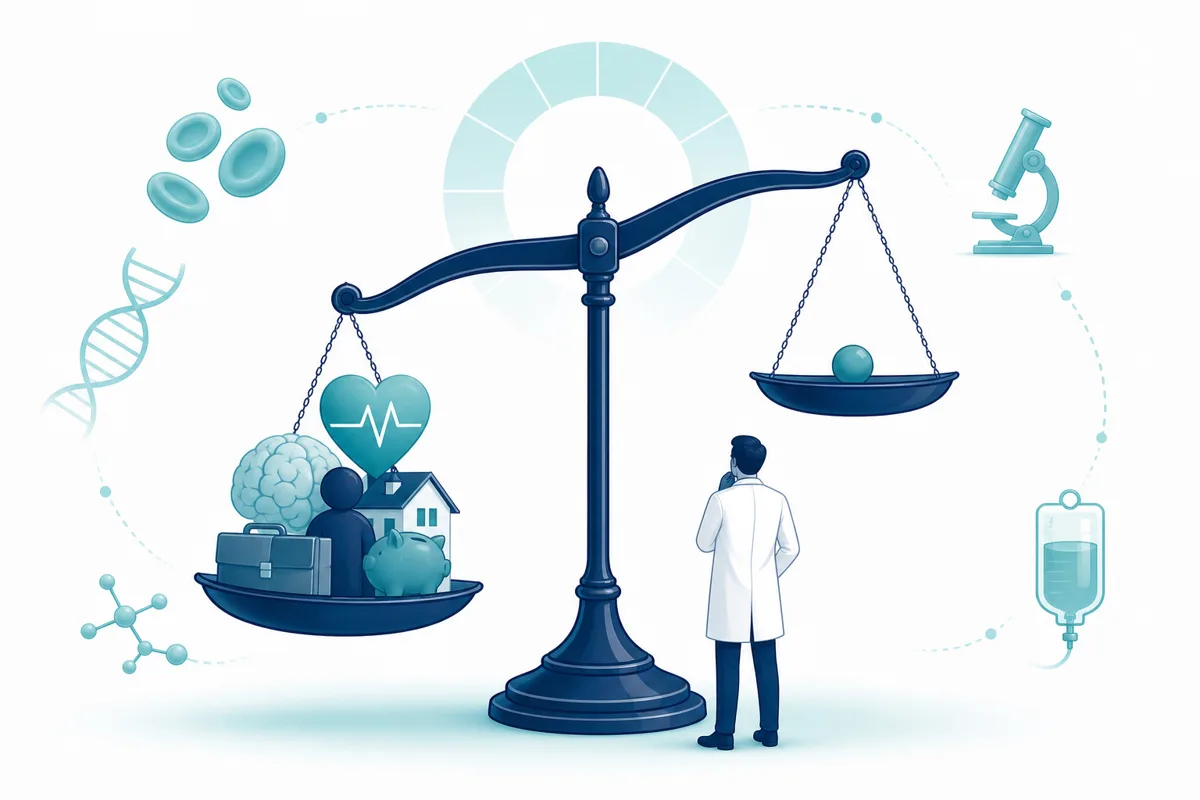
At the interview-invitation stage, across all specialties surveyed, the most cited factors were letters of recommendation in the fellowship specialty, residency performance evaluation (the program director letter), reputation of the residency program, demonstrated involvement and perceived interest in research, and perceived commitment to the specialty[4]. USMLE Step 1/COMLEX Level 1 score was cited by 74% of programs as a factor in interview decisions, and Step 2 CK/COMLEX Level 2 CE score by 72%[4], which tells you board scores still matter at the screening stage even though they rank behind letters and clinical performance.
At the ranking stage — after the interview — the calculus shifts even further toward relational and interpersonal signals. The top-cited factors in ranking applicants were interactions with faculty during the interview and visit (91%), interpersonal skills (91%), letters of recommendation in the fellowship specialty (79%), interactions with house staff during the interview and visit (77%), perceived commitment to the specialty (73%), and feedback from current residents and fellows (73%)[4]. Research involvement and peer-reviewed publications were cited, but they ranked below the interpersonal and commitment-signaling factors at this stage[4].
Programs also reported how often they interview and rank different applicant categories. U.S. MD graduates were typically interviewed and ranked by 97% of responding programs, osteopathic physicians by 87%, U.S. IMGs by 75%, and non-U.S. IMGs by 59%[4]. Only 29% of programs reported considering all applicant groups equally[4] — a useful, if sobering, data point if you're a U.S. or non-U.S. IMG deciding where to spend application dollars.
Does research matter for heme/onc?
At the ranking stage, the pattern holds: demonstrated involvement and perceived interest in research was cited by 71% of programs as a ranking factor, while peer-reviewed publications and authored textbook chapters were cited by 52%[4]. Compare that to interactions with faculty during interview (91%) or perceived commitment to the specialty (73%)[4] — research is a real line item on your application, but it is not what moves you from "interviewed" to "ranked highly."
Programs are split on whether dedicated research time is required at all: 60.5% of responding programs across specialties required dedicated research time, while 39.5% made it optional[4], and among programs requiring it, the average number of months required ranged from 9 to 12 depending on funding structure[4]. If you're choosing between squeezing out one more case report and getting a strong, specific letter from an oncologist who has actually worked with you clinically, the data says choose the letter.
How many programs should I apply to?
The published program director data doesn't give a single magic number, but it does show what the funnel looks like on the other side. Across all specialties surveyed, the average program received 98 applications, sent out 23 interview invitations, and interviewed 19 applicants[4] — meaning most programs convert roughly one in five applications into an actual interview, and nearly all invited applicants show up. Programs also reported rejecting an average of 68% of applicants through an in-depth review process, versus 34% rejected via a standardized screening process before individualized review[4].
Metric (program-reported average, across specialties) | Value |
|---|---|
Applications received per program | 98[4] |
Interview invitations sent per program | 23[4] |
Applicants interviewed per program | 19[4] |
Applicants rejected via in-depth review (not standardized screen) | 68%[4] |
Source: NRMP Program Director Survey, Specialties Matching Service[4].
The practical implication: a scattershot list of 10–15 applications submitted without regard to fit does less for you than a list targeted at programs where your letters, your residency's reputation, and your demonstrated interest actually line up with what that program says it weighs. Given that heme/onc filled 99.5% of positions in the most recent cycle[1], there is very little slack in the system for applicants who show up with a generic file and hope volume compensates for specificity.
What are the red flags on an application?
The survey data points to several factors that programs rate as carrying real weight, even though they rank below the top tier. Any failed attempt on USMLE/COMLEX was cited by 49% of programs at the interview stage and 44% at the ranking stage[4]. Gaps in medical education were cited by 40% of programs as a factor at the interview stage[4]. None of these are automatically disqualifying — they're factors with real but moderate weight, well behind letters of recommendation, residency performance, and perceived commitment to the specialty[4].
The more common, less dramatic red flag is simply a thin or generic commitment signal: a personal statement and letters that don't connect to anything specific you've done in oncology or hematology. Given that perceived commitment to the specialty was cited by 82% of programs at the interview stage and 73% at the ranking stage[4], an application that reads as "I want a subspecialty, any subspecialty" is a structural weakness even if every number on the file is strong.
If you're still deciding whether the fellowship is the right move at all — not just whether you can match — it's worth working through the financial trade-offs honestly before you build an application strategy around it. We've laid out the three-year math here, and a broader look at why residents choose this path at all here.
Once you match, how do you actually prepare for fellowship?
Matching is the first filter, not the last one — fellows are expected to perform from day one, on service and eventually on the ABIM exam. MeDucation AI's question bank for heme/onc fellows is reviewed by board-certified hematologist-oncologists; every explanation covers why the correct answer is right and why each distractor is wrong, with embedded images, tables, and direct PubMed links, plus AI read-aloud and adjustable text tools built around the reading experience. If you're still weighing your board-prep options once you're in a program, we've written about what's worth paying for and what isn't on our pricing and plans breakdown.
Frequently Asked Questions
When does the hematology-oncology fellowship match happen?
Hematology and Medical Oncology is a July Application Cycle specialty in ERAS[3], and results for the broader Medicine and Pediatric Specialties Match — which includes heme/onc — are released by NRMP[1][5]. Exact calendar dates shift slightly each cycle; check ERAS's and NRMP's own published calendars directly.
What happens if I don't match into heme/onc fellowship?
You remain a fully licensed internist with options. As one AMA source on this match puts it, not matching to a specific subspecialty "may limit your options to work in a highly specialized area, but you still have those skills as a physician to use in so many ways"[2], and applicants can reapply in a future cycle or pursue a different path with their existing training.