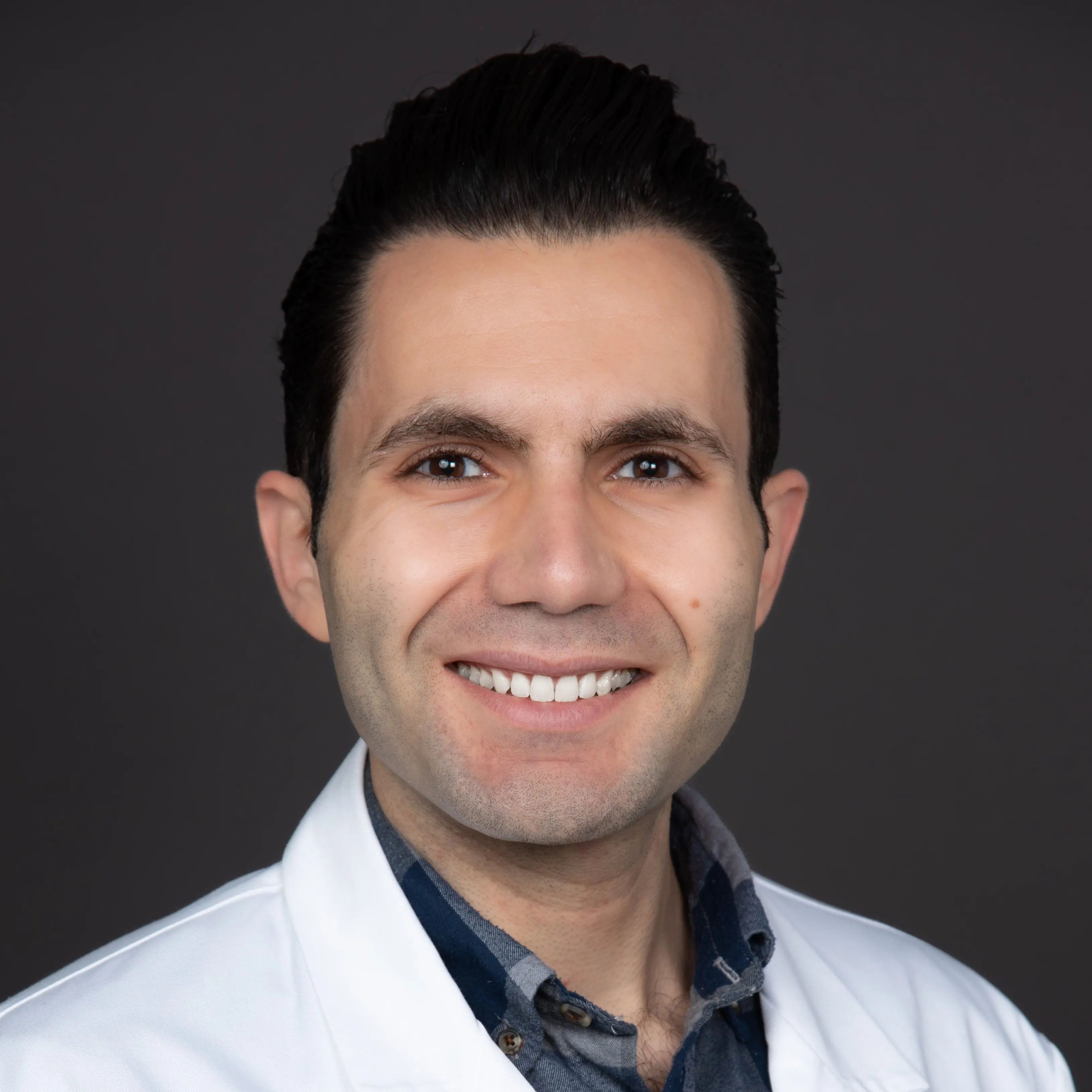
Written by Dr. Roupen Odabashian MD, FRCPC, FASC
Hematologist-Oncologist | Founder, MeDucation AI | Updated July 2026
What does MeDucation offer a fellowship program?
MeDucation AI offers hematology-oncology fellowship programs three institutional tools on top of what individual fellows get. First, a Program Director Dashboard: a program-level view of learner engagement and knowledge gaps, so you can see how your fellows are using the platform, where they are improving, and where more teaching is needed. Second, Attending Tools: guided workflows that let your faculty author board-style multiple choice questions and branching interactive clinical case simulations without the usual overhead. Third, a Program Library: a shared, searchable space to upload, organize, distribute, and track your program's own teaching material. Institutions buy this as a program license. MeDucation for all fellows plus the Program Director dashboard, at custom pricing.
Conflict of interest, stated up front: I am a practicing hematologist-oncologist and the founder of MeDucation AI. Read this accordingly. I have tried to write the document I would want to receive as a program director, including what the product does not do and what has not been proven, not the one a marketing team would want me to send.
What are the three institutional tools?
Tool | What it does | Who it's for |
|---|---|---|
Program Director Dashboard | A clear program-level view of learner engagement and knowledge gaps. Shows how fellows are using the platform, where they are improving, and where additional teaching may be needed. | Program directors, associate PDs, GME leadership, core faculty who sit on the education committee. |
Attending Tools | Two authoring workflows: (1) board-style multiple choice questions with stems, answer choices, and detailed explanations for correct and incorrect options; (2) interactive clinical case simulations, branching scenarios covering diagnostic reasoning, workup, and management decisions. | Attendings and core faculty, the people whose clinical expertise usually dies at the end of a tumor board. |
Program Library | A shared space to upload, organize, and distribute learning material across the program, with access control, threaded discussion, and usage analytics. | The whole program: PDs, coordinators, faculty, and fellows (who contribute, not just consume). |
What does the Program Director Dashboard actually show?
It gives you a program-level view of learner engagement and knowledge gaps. Concretely: you can track how your fellows are using the platform, see where they are improving, and see where additional teaching may be needed.
Let me be exact about the boundary, because dashboards are where edtech vendors overreach. This one is a teaching signal, not an assessment instrument. It tells you your second-years are collectively soft on plasma cell disorders and that nobody has touched the transplant material in six weeks. That is useful for the curricular self-examination the ACGME already expects, the Common Program Requirements ask programs to review aggregate data annually and use it to improve the curriculum[1]. Knowing where the collective gaps are before your Program Evaluation Committee meets is worth something.
What it is not is a Milestones engine. MeDucation does not map to ACGME Milestones and does not feed your Clinical Competency Committee. The CCC's synthetic judgment is built from your own assessment ecosystem and the Milestones framework[2], and I will not pretend a question-bank dashboard substitutes for that. Use it as one more input, the way you'd use ITE topic breakdowns.
Can our faculty write their own questions and cases?
Yes, and this is the part of the institutional offering I care most about, because it addresses a problem I lived.
Every program has attendings who teach beautifully at the bedside and produce nothing durable. Not laziness. Writing a genuinely good multiple choice question is slow, technical work, a clean stem, plausible distractors, a defensible single best answer, an explanation that teaches rather than asserts. The item-writing literature is explicit that this is a skill with rules and that doing it well takes real time[3]. Meanwhile hematologists and oncologists already carry an administrative load that measurably crowds out patient care and contributes to burnout[4]. Asking that person to also produce twenty polished MCQs is how you get zero MCQs.
The Attending Tools give faculty two guided workflows:
Multiple choice question authoring. A structured path through the stem, the answer choices, and detailed explanations for the correct answer and each incorrect option. The explanation-for-every-distractor discipline is what turns a test item into a teaching item.
Interactive clinical case simulation authoring. Branching clinical scenarios that walk a fellow through diagnostic reasoning, workup, and management decisions. This is the closest thing I have found to bottling how an attending thinks out loud on rounds, the fellow makes a choice, and the case moves.
The output stays inside your program. If your myeloma attending builds four cases, your fellows get four cases reflecting how your institution practices, not always what a national bank teaches.
What is the Program Library?
The Program Library is a shared space to upload, organize, and distribute learning material across an organization. Most programs currently do this with a shared drive nobody opens and a Slack channel where PDFs go to die. This is that, with structure and feedback.
Upload anything. PDFs, lecture slides, guidelines, review papers. No formatting requirements, you do not have to reauthor material to put it in.
Organize by year and by topic. First-, second-, and third-year fellows see what is relevant to them; content is also sorted by disease, organ system, or clinical theme.
Share with control. Push a resource to the entire program at once, or target an individual fellow or a small group. Fellows can also contribute material to their peers, it is a two-way library, not a top-down archive.
Interact with the material. Preview any document before diving in. Threaded comments sit on each resource, so the conversation lives with the paper instead of in someone's inbox. Fellows can recommend standout resources, so high-yield material rises to the top.
See what is actually being used. Usage analytics track engagement per resource, what is being opened, read, and returned to, and what is being ignored. You can also see how each piece of content feeds into fellows' Learning Hubs: whether they are generating flashcards, quizzes, or notes from it. That lets you identify high-impact material and double down on what works.
What do the fellows themselves get?
The program license provisions MeDucation for every fellow: a question bank of 1000+ questions written and reviewed by practicing board-certified hematologist-oncologists, not AI-generated, with explanations for every answer choice and direct PubMed references; a Notebook with mind maps, a knowledge graph, and FSRS spaced-repetition flashcards; a Learning Hub where a fellow uploads a PDF and gets board-style quizzes, flashcards, and exportable animated PowerPoint lectures; Mind Palace, which turns uploaded lectures into narrated personalized video; a curated Podcast Radio Station of real, human-hosted heme/onc podcasts (explicitly not AI-generated audio) selected by practicing oncologists; and flashcard deck sharing across the program. Detail on the fellow-facing side is on the hematology-oncology features page.
The spaced-repetition and retrieval-practice pieces are not marketing inventions, spaced education has held up in randomized trials in medical learners[5], and spacing, interleaving, and retrieval practice remain among the better-supported strategies we have[6]. What has not been shown is that any particular product built on those principles moves board pass rates.
Should we buy this if we already have ASCO-SEP or ASH-SAP?
Most programs I talk to already subscribe to one or both. ASCO offers SEP to training programs at a group discount[7], and ASH-SAP is the long-standing hematology self-assessment reference[8]. I am not going to tell you MeDucation replaces them. It doesn't. Here is the honest split:
Need | What a society bank (ASCO-SEP / ASH-SAP) already gives you | What MeDucation adds |
|---|---|---|
Authoritative specialty content | Yes, society-authored, the reference standard fellows and PDs already trust. | An additional physician-written, PubMed-referenced bank (1000+ questions, not AI-generated), supplementary, not a replacement. |
Norm-referenced percentile scoring | Yes, established banks have cohort data, which matters when you want to know where a fellow sits against peers. | No. MeDucation has no norm-referenced percentile scoring. A real limitation; I will not dress it up. |
Faculty authoring their own questions and cases | No. You consume the society's content; you cannot add your own. | Yes, MCQ authoring and branching clinical case simulation authoring, with explanations for every distractor. |
Program-level visibility into engagement and knowledge gaps | Limited to what the bank reports back to you. | Program Director Dashboard: engagement and knowledge-gap view across the fellowship. |
Distributing and tracking your own teaching material | Not in scope. | Program Library: upload, organize by year and topic, targeted sharing, threaded discussion, per-resource usage analytics. |
Fellow-facing study infrastructure (spaced repetition, mind maps, lecture-to-quiz, podcasts) | Not in scope. | Included for every fellow under the program license. |
If what you need is a validated, normed board bank, keep ASCO-SEP and ASH-SAP. MeDucation is additive where those tools are silent: faculty authoring, program-level visibility into knowledge gaps, and the distribution and tracking of your own teaching material.
How much does a program license cost?
Institutional pricing is custom. The program license is "MeDucation for all fellows + Program Director dashboard," priced per program rather than published. There is also a Medical School Site License. For reference, the individual heme/onc fellow plan is $225/year, which works out to $18.75/month, with shorter terms available at $149 for 3 months and $180 for 6 months; current plans are on the pricing page.
I will not quote a per-seat number, a minimum, or a contract length here, because those are negotiated and I would rather you get a real answer than a number I invented in a blog post. If you want one, write to info@meducationai.com.
How would we know if it's working?
Here is the part most vendors skip. There is no published outcome study showing that MeDucation improves in-training exam scores or board pass rates. None. And to be fair to everyone in this space: there is no such study for our competitors either. The whole category sells on mechanism and plausibility, not randomized outcome data. Anyone who implies otherwise is overselling.
So do not take my word for it. Pilot it and measure it:
Metric | How to measure | Over what period |
|---|---|---|
Knowledge movement | ITE score change for the pilot cohort against your own historical baseline at the same training level. Look at topic subscores, not just the composite. | One academic year (baseline ITE to next ITE). |
Actual engagement | Program Director Dashboard: proportion of fellows active weekly, questions attempted per fellow. A tool nobody opens helps nobody, this is where most edtech pilots quietly die. | Rolling; review at 4, 8, and 12 weeks. |
Faculty time saved (or spent) | Have 3-5 core faculty self-report time to produce one teaching artifact before vs. using the Attending Tools. Crude, but honest, and if it takes them longer, you need to know. | One 8-12 week block. |
Teaching-material reach | Program Library usage analytics: what fraction of posted resources are opened, by whom, and which ones fellows return to or convert into flashcards and quizzes. | One semester of didactics. |
Fellow-reported value | Two-question anonymous survey at pilot end: would you keep it, and what would you drop it for? | End of pilot. |
Pick one cohort. Declare your primary metric before you start, ITE topic-subscore movement or faculty time, depending on the problem you are actually trying to solve. Run it for a defined period. Then decide. That is also, not incidentally, the kind of data-driven curricular review your Annual Program Evaluation is supposed to be doing anyway[1].
If you are building AI into your curriculum more broadly, we have written a step-by-step guide to building an AI curriculum for a training program and a practical AI policy template, both worth reading before you bring anything, including us, to your GMEC.
Frequently asked questions
Does MeDucation map to ACGME Milestones or feed our Clinical Competency Committee?
No. MeDucation does not have ACGME milestone mapping, and I would not want a PD walking into a CCC meeting believing otherwise. The Program Director Dashboard shows engagement and knowledge gaps at the program level; treat it as one input, not a Milestones instrument. If milestone integration is a hard requirement, ask about it directly before you buy.
Does it do SSO, LMS integration, or data export?
I will not claim capabilities I cannot verify for you here. SSO, LMS integration, and data export are exactly what your GME office and IT will ask about, and they deserve a straight answer from someone who can check the current state of the platform, so put those questions to us directly before signing anything. Same for data privacy posture and any compliance certifications. Do not assume; ask.
Is the question bank AI-generated?
No. The 1000+ questions are reviewed by practicing board-certified hematologist-oncologists, with explanations for every answer choice and direct PubMed references. However, we use AI to write high quality quesitons. The podcast station is a curated collection of real, human-hosted heme/onc podcasts selected by practicing oncologists, not synthetic audio. AI is used in the study tools (turning a PDF into quizzes, flashcards, mind maps, lectures), not to author the core question content.
Can fellows contribute to the Program Library, or only faculty?
Both. Fellows can share material with peers, recommend standout resources so high-yield content rises to the top, and comment in threaded discussions on any resource. It is deliberately two-way. The most useful review article in most programs is found by a fellow, not assigned by a PD.
Does MeDucation give us percentile scores against a national cohort?
No. There is no norm-referenced percentile scoring. Established society banks like ASCO-SEP and ASH-SAP have cohort data that MeDucation does not have. If percentile benchmarking is central to how you counsel fellows, keep the society bank for that purpose.
What is the fastest way to evaluate this for our program?
Run a single-cohort pilot with one pre-declared primary metric over a defined period, using the table above, then decide on your own data. Given the absence of published outcome evidence anywhere in this category, that is the only intellectually honest way to buy any of these tools, mine included.
References
ACGME Common Program Requirements (Residency), 2025 reformatted edition. Accreditation Council for Graduate Medical Education.
The Milestones Guidebook. Accreditation Council for Graduate Medical Education.
Gottlieb M, et al. Educator's blueprint: A how-to guide for developing high-quality multiple-choice questions, AEM Education and Training, 2023.
Exploring the administrative burden faced by hematologists. Global & Regional Health Technology Assessment, 2024.
Kerfoot BP, et al. Spaced education improves the retention of clinical knowledge by medical students: a randomised controlled trial. Medical Education, 2007;41(1):23-31.
The Effectiveness of Spaced Learning, Interleaving, and Retrieval Practice. Journal of the American College of Radiology.
ASCO-SEP for Training Programs. American Society of Clinical Oncology.
ASH Self-Assessment Program (ASH-SAP). American Society of Hematology.