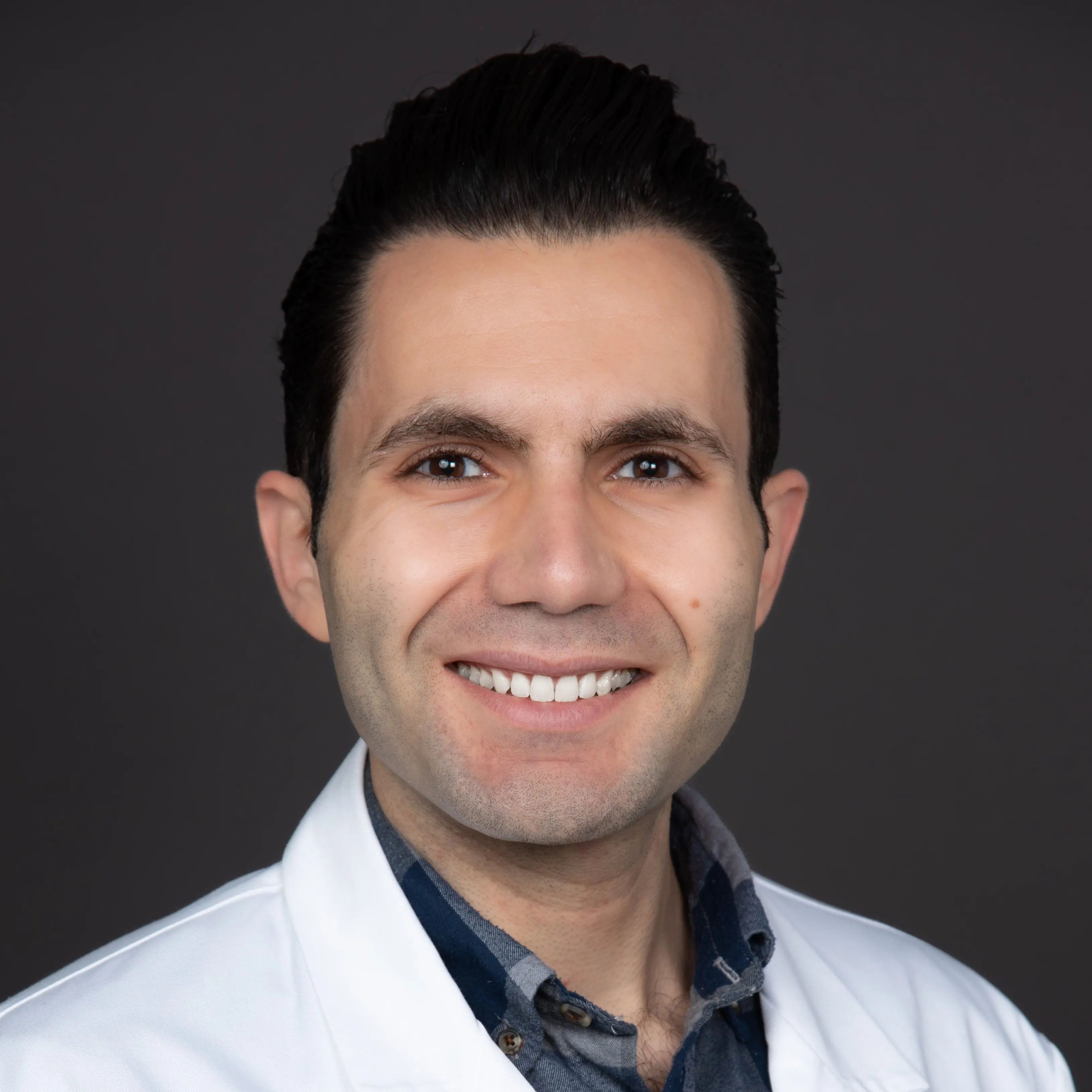

By Dr. Eliana van Engelen Medical Student at ETH Zürich
Dr. Roupen Odabashian, MD, FRCPC, FASCm Hematologist-Oncologist | Founder, MeducationAI
Published April 2026
An AI medical tutor is a conversational, adaptive learning tool that explains medical concepts, quizzes you in real time, and adjusts to your knowledge gaps — and the category exploded in 2025–2026 as several platforms moved from novelty to genuinely useful study companions. This guide cuts through the marketing noise with a working definition, an honest comparison against traditional question banks, and a side-by-side review of the top tools for medical students, residents, and fellows.
TL;DR
An AI medical tutor is a dialogic learning tool — it explains concepts, generates targeted questions, tracks your weak areas, cites peer-reviewed sources, and walks through clinical reasoning rather than just delivering facts.
AI tutors and question banks solve different problems. Use a Qbank (UWorld, AMBOSS, MeducationAI) as your primary assessment engine and an AI tutor for the conceptual "why" — never as a substitute during dedicated board prep.
The strongest 2026 options are medicalstudent.ai (Sina) for citation-grounded answers, Neural Consult (GLIA) for case simulation, AMBOSS AI for library-grounded review, and MeducationAI (Hippocrates) for IM and heme-onc subspecialty depth.
Use AI tutors actively: command them to quiz you, retrieve before you prompt, and verify high-stakes claims (drug doses, trial outcomes, guidelines) against UpToDate, NCCN guidelines (see our practical guide to reading NCCN guidelines), or primary literature.
The biggest failure mode is passive consumption. AI tutoring only works if it forces you to think.
What is an AI medical tutor?
An AI medical tutor is a dynamic, conversational learning tool designed to explain complex medical concepts, proactively ask you questions, walk through clinical reasoning, and adapt to what you do not yet understand. Unlike a traditional question bank — which presents a multiple-choice stem followed by a static, one-size-fits-all explanation — an AI medical tutor engages in back-and-forth dialogue until the concept actually lands.
The reality of the medical education market in 2026, however, is much messier. The term "AI tutor" has been applied to everything from a thin ChatGPT wrapper to a tightly grounded, citation-anchored clinical reasoning engine. Trainees deserve a clear framework for telling these apart.
From my experience training fellows in hematology-oncology and building MeducationAI, the fundamental rule is simple: the AI medical tutor only works if it forces you to think. Passive consumption, letting the model generate long explanations you skim, is worse than not using one at all.
This article establishes a working definition of the technology, provides a side-by-side comparison against traditional question banks, reviews the most credible platforms in 2026, and ends with five non-negotiable rules I give to the residents and fellows I train.
What counts as an AI medical tutor? A working definition
A real AI medical tutor must execute at least three of the following five behaviors: it explains concepts in active dialogue, tests you actively, adapts to your knowledge gaps over time, cites peer-reviewed sources for factual claims, and builds clinical reasoning rather than just first-order recall. Anything less is a chatbot, not a tutor.
Explains concepts in active dialogue. You must be able to ask hyper-specific follow-up questions and have the model respond coherently to your specific gap, not regurgitate a canned answer.
Tests you actively. It generates targeted questions, forces you to commit to an answer before moving on, and only then explains.
Adapts to your knowledge gaps. It maintains state — tracking what you got wrong on Tuesday so it can re-test you on Friday.
Cites the source. Every factual statement should be linked to peer-reviewed literature or guideline-level material, not invented from the model's pretraining.
Builds clinical reasoning, not just recall. It moves beyond trivia to differential diagnoses, regimen selection, and trial-level "why" discussions.
A general-purpose tool like standard ChatGPT can accomplish (1) and parts of (2), but it cannot reliably do (3), (4), or (5). That is why purpose-built medical platforms exist.
AI tutor vs. question bank: a side-by-side comparison
An AI medical tutor and a question bank serve fundamentally different functions: the tutor is built for conceptual understanding through dialogue, while the question bank is built for assessment and exam alignment through validated multiple-choice items. Top scorers use both — never one as a substitute for the other.
Dimension | AI Medical Tutor | Question Bank (UWorld, AMBOSS Qbank, etc.) |
|---|---|---|
Primary mode | Conversational dialogue, Socratic questioning, dynamic simulation | Multiple-choice questions with static explanations |
Adaptability | High. Answers nuanced follow-ups and drills weak areas in real time | Limited. Adaptive only at the question-selection layer |
Best used for | Concept understanding, clinical reasoning, the "why" behind pathophysiology | Board-aligned assessment and exam-day pattern recognition |
Risk of passive learning | High. If you let the AI lecture you without testing, you absorb little | Low. Forces commitment to an answer before revealing the explanation |
Risk of misinformation | Real. Hallucinations are possible unless tightly grounded in verified literature | Very low. Items are physician-written and peer-reviewed |
Exam validation | Variable. Mostly unproven in large-scale outcomes data as of 2026 | Strong. Highly correlated with USMLE, COMLEX, and ABIM board scores |
Cost profile | Free to ~$30/month for most specialized AI tools | $200–$600/year depending on subscription length |
Ideal schedule use | Daily concept work, case discussion, deep-dive review after a missed question | Dedicated, timed practice blocks; final 3–6 months of board prep |
The honest takeaway: An AI tutor is not a replacement for a premium Qbank during dedicated board prep. Conversely, a Qbank cannot replicate the conversational depth a true AI tutor provides when you are stuck on a complex mechanism. The students and residents who score highest use both in tandem. For a structured study plan showing exactly how to combine these tools, see our 6-month ABIM board prep guide.
The five things a good AI medical tutor does
A good AI medical tutor forces retrieval before explanation, uses spaced repetition, cites high-fidelity sources, walks through clinical reasoning, and closes the loop on assessment. These behaviors are grounded in cognitive-science research on durable medical learning — not marketing.
Forces retrieval before explanation. Retrieval practice produces significantly more durable learning than re-reading notes or creating concept maps. A good AI tutor demands you commit to an answer before it teaches.
Uses spaced repetition algorithms. The Boonshoft cohort study found that first-year medical students who consistently used spaced repetition tools like Anki performed measurably better on board-style assessments. AI tutors that integrate spacing inherit this benefit — and the underlying research on AI in medical education continues to support this layered approach.
Cites high-fidelity sources. Citation grounding is non-negotiable. The 2024 Goh et al. JAMA Network Open trial showed that LLM use without proper grounding can introduce diagnostic reasoning errors — exactly the failure mode trainees cannot afford.
Walks through clinical reasoning, not just raw facts. A tumor-board-style discussion of why one chemotherapy regimen is preferred — what favors it, what could change the choice — is the actual currency of clinical practice.
Closes the loop on assessment. A 2025 npj Digital Medicine study found that student usage of a generative AI teaching assistant correlated with improved performance only when assessment was integrated into the workflow.
Top AI medical tutors reviewed in 2026
The strongest AI medical tutors in 2026 are medicalstudent.ai (Sina), Neural Consult with the GLIA tutor, AMBOSS AI Mode, MeducationAI's Hippocrates assistant, and Tiber Health's curriculum-native tutor in closed beta with PHSU. Each solves a different piece of the learning workflow — pick based on your stage of training and your primary friction point.
For this review, I focused on platforms that explicitly market themselves as medical tutors, intentionally setting aside generic chatbots and pure question banks.
medicalstudent.ai (Sina) — the citation-grounded reference tutor
medicalstudent.ai, branded as "Sina," is one of the most visible products when searching for an AI medical tutor. Its core differentiator is rigorous citation grounding, every claim is anchored to peer-reviewed literature or named guideline material, which directly addresses the LLM hallucination problem that plagues open-ended chatbots.
The honest read: Its greatest strength is reliability. If your friction point is "I need a trustworthy answer fast," medicalstudent.ai is an excellent fit. If your friction point is "I do not even know what questions I should be asking to understand this," a more dialogic, simulation-style tutor will serve you better.
Neural Consult with GLIA — the tutor inside a study platform
Neural Consult is a comprehensive study platform with an embedded AI tutor named GLIA integrated across its toolset. It includes a Clinical Case Simulator with AI patients, AI Medical Search, an Exam Question Generator, an AI Flashcard Hub, an AI Notebook, integrated Study Sessions, and a File Drive. Pricing as of 2026: free Starter tier, Monthly Pro at $24.99, Annual Pro at $224.99.
The honest read: Neural Consult comes closer to true pedagogical tutoring than most competitors because GLIA is embedded directly inside study workflows, patient simulation, question generation, flashcards — rather than living in a separate chat window.
Best for: MS3 and MS4 students who want clinical case practice integrated with their primary study tools rather than scattered across multiple apps.
AMBOSS AI Mode — the tutor layered on a curated knowledge library
AMBOSS pairs a rigorous Qbank with an exceptional curated reference library, and its AI features (AI Mode and AMBOSS Assistants) sit on top of that physician-edited content rather than running on raw model knowledge. That architectural choice keeps hallucinations rare and answers tightly aligned with what shows up on shelf and step exams.
The honest read: The AI here is strategically layered on top of tightly controlled, physician-edited content. That is the safest design pattern for high-stakes specialty content and is one of the reasons AMBOSS is a default choice for many US clerkship students.
Best for: Students already deeply embedded in the AMBOSS ecosystem who want their existing reference library to become conversational and adaptive.
MeducationAI (Hippocrates) — the subspecialty-depth tutor
MeducationAI is built around AI-explained multiple-choice questions, automated spaced repetition, and Hippocrates, an AI assistant tuned specifically for Medical Students, internal medicine and hematology-oncology depth rather than broad preclinical content. (Disclosure: I am the founder of this platform.)
What makes hippocrates is different and unique is Hippocrates learns from your mistakes and adopts its questions in the future
Beyond the chatbot, there are so many other tools that personalise learning
Best for: Medical Students, Senior medical students pursuing internal medicine, IM residents, and hematology-oncology fellows who need trial-level reasoning rather than first-order recall.
Tiber Health AI Tutor, the closed-beta, curriculum-native tutor
Announced in March 2026, Tiber Health Innovation partnered with Ponce Health Sciences University (PHSU) to launch an AI tutor trained directly on institutional curriculum content. Access is currently restricted to PHSU students through a closed beta.
The honest read: This product is worth monitoring because it represents the next evolution of the technology — an AI tutor trained on a specific medical school's lectures, assessments, and clinical materials, rather than on the open internet. Expect at least one major medical institution to copy this model in 2026–2027.
Best for: Currently restricted to PHSU students. Watch for wider institutional rollouts throughout 2026 and 2027.
Who benefits most: students vs. residents vs. fellows
The right AI medical tutor depends on the training stage. Preclinical students benefit from concept-explanation tutors paired with Anki, clinical students need reasoning-focused dialogic tools, residents need subspecialty-aligned drilling, and fellows need trial-level decision support. One tool rarely covers all four stages well.
Medical students (MS1–MS2): concept building and recall
During the preclinical years, students benefit most from tutors that explain complex pathophysiology in plain dialogue, paired heavily with active recall testing. The holy trinity of preclinical studying remains a strong Qbank for board alignment, Anki for rote memorization, and an AI tutor for the "explain this to me like I have never seen a kidney before" moments. medicalstudent.ai's Study Mode, AMBOSS AI, and Neural Consult are the strongest fits at this stage.
Medical students (MS3–MS4): clinical reasoning
Once on the wards, clinical students must transition from fact memorization to clinical pattern recognition. The right AI tutor is one that simulates patient encounters, walks through differentials, and pressure-tests management decisions — not one that hands you a polished USMLE-style answer.
The ultimate danger at this stage is letting the AI do the reasoning for you. If you outsource the differential, you do not learn to build one. Use AI tutors to verify and refine your reasoning after you have committed to it.
Residents: subspecialty depth and board alignment
Residents operate with a severe time deficit and require specificity. An AI tutor that does not understand the difference between an ABIM blueprint topic and a USMLE Step 2 topic is not useful. Look for platforms that explicitly tag content to the ABIM blueprint and that drill the actual high-yield disease categories (oncologic emergencies, antimicrobial choice, cardiology pharmacotherapy).
Fellows: trial-level depth and decision support
Fellows must push past textbook summaries and into trial-level reasoning. Why did this specific regimen win? What was the comparator arm? What subgroup analysis would change your decision tomorrow on a real patient? At this stage, the best AI tutors function less like a textbook and more like a senior co-fellow who has read every pivotal trial and can quiz you on them. For program-level guidance, see our framework on AI in hematology-oncology fellowship training.
Where AI medical tutors consistently fall short
Even the best AI medical tutors in 2026 have three reliable failure modes: confident hallucinations, no validated outcomes benchmark for tutoring quality, and a strong pull toward passive consumption. Knowing these limits is the difference between using AI tutors well and getting burned by them.
Hallucination and confident wrongness. Even platforms grounded in strict citations will occasionally synthesize concepts incorrectly — and they will do so with full confidence. Always verify dosing, trial outcomes, and guideline-level recommendations against UpToDate, NCCN, or the primary literature.
No validated benchmark for tutoring quality. If you score in the 80th percentile on UWorld, there is a proven correlation with board pass rates. There is no equivalent validated benchmark for "AI tutor performance" predicting exam outcomes — the data simply does not exist yet at scale.
The risk of passive consumption. This is the single biggest failure mode I observe in trainees. Students increasingly use AI as a frictionless explainer rather than a quizzer. The model gives a polished answer, the student nods along, and almost nothing transfers to long-term memory. The AI medical tutor only works if it forces you to think.
How to get the most out of an AI medical tutor

To use an AI medical tutor well, retrieve before you prompt, command it to quiz you, verify high-stakes claims, pair it with a traditional Qbank, and disclose AI use when required. These five rules — which I give to every fellow and resident I train — turn the tool from a passive lecture into actual learning.
Retrieve before you prompt. Always attempt to explain the concept yourself — out loud or on a whiteboard — before you ask the AI for the answer. Use the AI to fill the specific gap you identified, not to do the initial lifting.
Command it to quiz you. Most AI tutors default to explaining. Override that. Try: "Quiz me on the management of febrile neutropenia, one question at a time. Do not give me the answer or explanation until I commit to a choice." That single instruction transforms the experience.
Verify high-stakes claims. If the AI gives you a specific drug dosage, a pivotal trial outcome, or a guideline-level recommendation — stop. Cross-check against UpToDate, NCCN, or the primary literature before you act on it.
Pair it with a traditional Qbank. Use your Qbank as your primary assessment tool. When you miss a question and the static explanation does not land, take the core concept to your AI tutor for clarification and interactive drilling. The Qbank assesses; the AI teaches.
Disclose AI use when required. Most medical schools now allow AI-assisted studying but strictly prohibit AI-assisted graded coursework. When in doubt, ask your attending or course director directly.
Frequently Asked Questions
Is an AI medical tutor accurate?
Accuracy varies enormously based on the underlying architecture. Tutors strictly grounded in peer-reviewed citations — such as medicalstudent.ai and AMBOSS AI — are vastly more reliable than open-ended models like raw ChatGPT. However, every LLM still produces occasional errors, so you must independently verify high-stakes facts (drug doses, trial outcomes, formal guidelines) against UpToDate, NCCN, or primary literature before clinical use.
Is an AI medical tutor free?
Some are partially free. Platforms like Neural Consult offer a free Starter tier, with premium plans typically ranging from $20 to $30 per month. medicalstudent.ai has both free and paid tiers. Traditional question banks like UWorld and AMBOSS Qbank remain a separate, significantly larger investment in the $200–$600/year range, so an AI tutor and a Qbank are typically additive purchases rather than substitutes.
How does an AI medical tutor compare to UWorld?
They do entirely different jobs. UWorld is a board-aligned assessment tool with physician-written questions and validated correlation to actual exam scores — it tells you whether you are ready. An AI medical tutor is a conversational explainer designed to teach you the underlying concept after you miss a question. The highest-scoring students use UWorld to assess and an AI tutor to remediate the specific gaps UWorld exposes.
Can AI completely replace a human tutor or attending physician?
No, and the current literature is unequivocal. Human attendings provide nuanced clinical judgment, context-specific feedback, and mentorship that no current LLM replicates. AI medical tutors are best thought of as a 24/7 study partner that supplements — never replaces — bedside teaching, attending feedback, and structured curriculum. Treat the AI tutor as a high-throughput drill partner; treat your attendings as the source of clinical judgment.
Which AI medical tutor is best for hematology-oncology fellows?
For hematology-oncology fellows preparing for ITE and ABIM boards, MeducationAI's Hippocrates assistant is purpose-built for subspecialty depth and trial-level reasoning, while AMBOSS AI offers strong library-grounded support for general internal medicine content. Pair either with a dedicated Qbank for board-aligned assessment. Generic ChatGPT is not adequate at the fellow level because it lacks reliable citation grounding and frequently misses subgroup nuance in pivotal oncology trials.
How should I use an AI medical tutor without becoming a passive learner?
Make the tool quiz you before it explains anything. Use a prompt like: "Quiz me on this topic one question at a time. Do not reveal the answer or explanation until I commit to a choice." Always attempt to retrieve the concept yourself before asking. Verify high-stakes claims against primary sources. If you find yourself reading long AI-generated explanations without being tested, you have already drifted into passive consumption.
References
Karpicke JD, Blunt JR. "Retrieval Practice Produces More Learning than Elaborative Studying with Concept Mapping." Science. 2011;331(6018):772–775.
Gilbert MM, Frommeyer TC, Brittain GV, et al. "A Cohort Study Assessing the Impact of Anki as a Spaced Repetition Tool on Academic Performance in Medical School." Boonshoft School of Medicine Cohort Study. 2023.
Goh E, Gallo R, Hom J, et al. "Large Language Model Influence on Diagnostic Reasoning: A Randomized Clinical Trial." JAMA Network Open. 2024.
"A generative AI teaching assistant for personalized learning in medical education." npj Digital Medicine. 2025.
Medical Student AI (Sina). Product homepage. Accessed April 2026.
Neural Consult. Product homepage. Accessed April 2026.
AMBOSS. "Discover AI-Powered Medical Intelligence from AMBOSS." Accessed April 2026.
MeducationAI. "Medical Students." Accessed April 2026.
Tiber Health Innovation. "Groundbreaking AI Tutor for Medical Education from Tiber Health Innovation Launches Closed Beta with PHSU." March 2026.
Zhang JS, Yoon C, Williams DKA, Pinkas A. "Exploring the Usage of ChatGPT Among Medical Students in the United States." Journal of Medical Education and Curricular Development. 2024;11:23821205241264695.
Glass Health. "Features." Accessed April 2026.
Ready to see what a subspecialty-trained AI medical tutor actually feels like? Try MeducationAI's Hippocrates assistant alongside our heme-onc question bank — built by hematologist-oncologists, grounded in peer-reviewed evidence, and designed to quiz you before it explains anything.